Search

tuannyriver

website & blog of Tuan Hoang, Pepperdine University

The Vietnamese equivalent to the Beatles’ Yesterday

Comparisons of music in different languages and styles could be a hazardous affair.  Even at its best, a comparison could be pretty inexact because one could locate as many divergences and differences as parallels and similarities, if not more.  And the differences may be too strong to render similarities ineffectual.  With this caveat, I nonetheless wish to give this comparison a try.

toiduaemsangsong

A few months ago, I suggested that the Vietnamese equivalent to Where Do I Begin?, the theme song of the movie Love Story, is a ballad by Trần Thiện Thanh about a young couple in wartime.  The song was based on a true story, albeit the deceased at the end is the man rather than the woman as in the novel and movie.  There was also temporal proximity, as the Vietnamese song was written and produced two or three years after the release of the sentimental American movie.  In other words, both songs came out of the early Seventies.

Continue reading “The Vietnamese equivalent to the Beatles’ Yesterday”

Lịch sử nước Mỹ #1 – Bài giới thiệu về di dân

Lịch sử nước Mỹ không dài bằng nhiều nước khác, mặc dù các chứng tích khảo cổ và địa chất định rằng người da đỏ có mặt ở Mỹ Châu hàng chục ngàn năm xưa.  Vì quá ít chứng tích tài liệu ngôn ngữ, nên hầu hết thời gian trước ông Columbus được coi là “Đất Mỹ thời tiền sử.”  Nhưng từ cuối thế kỷ 15, lịch sử đất này thay đổi mau chóng có nhiều tiến triển cũng như vấn đề, nhất là về đa dạng các chủng tộc và sắc tộc nhân loại.

US-By-Race1

Từ hướng Á Châu đi qua biển Bering đến lục địa mới, người da đỏ đã sống khắp Nam Mỹ và Bắc Mỹ bao nhiêu thế kỷ.  Rồi người da trắng bắt đầu qua vào thế kỷ 16, khi hai đế quốc Tây Ban NhaBồ Đào Nha gởi người qua thám hiểm đất đai, kiếm vàng kiếm bạc, giảng đạo Công Giáo.  Họ dùng quân đội xâm chiếm nhiều khu vực, rồi mở đồn điền trồng trọt, nhất là tại Nam Mỹ và các đảo vùng biển Caribe ở Châu Mỹ Latin. Sau này họ mua người da đen bên Phi Châu làm nô lệ lao động ở những đồn điền này.

Continue reading “Lịch sử nước Mỹ #1 – Bài giới thiệu về di dân”

History of American immigration & ethnicity in Vietnamese

It is not easy to find a redeeming feature about driving to work in metro Los Angeles.  But there is one thing that I like about my commute: reaching the end of Interstate 10 and turning into the Pacific Coast Highway, known locally as PCH.  Not only there is less traffic in the morning, but the sight and sound of the ocean emerge pleasantly – and, sometimes, the smell.  Even when dark or cold or foggy, the remaining fifteen miles of the commute have helped to lower heartbeats, lessen blood pressure, relax the mind, and, on occasions, conjure up visions and possibilities before attending to the specific and quotidian that make up the bulk of the work day.

12042847_10153610465358847_2637634305403672921_n
An early morning last October with PCH beneath the hills on the lower left ~ pc Hung Le at Pepperdine

Continue reading “History of American immigration & ethnicity in Vietnamese”

Vietnamese in Central & Eastern Europe

Update Jan 27, 2016:  I’ve reviewed the dissertation for the website Dissertation Reviews.

On New Year’s Eve, I finished reading a terrific dissertation about Vietnamese in the former Czechoslovakia.  The author is Alena Alamgir (Rutgers 2014), and her work is about a bilateral labor program between the DRV and Czechoslovakia from 1967 to 1989 that sent Vietnamese from the European country for training and work in a variety of industries. The field is historical sociology – it won the Theda Skocpol Award from the American Sociological Association last year – and the dissertation utilizes a good deal of documents from the National Czech Archives, including materials from three governmental agencies in the Cold War era.

Continue reading “Vietnamese in Central & Eastern Europe”

I speak with my hands!

I just had a really good semester in the classroom, the best at Pepperdine.  In the first two years, I had some good classes and even three or four great ones: “great” means you cannot ask for more.  But for each semester there was at least one class out of three or four (depending on the semester) that was average at best or, at least once in my first year, quite sub-par.  Well, not this fall.  If the third time is the charm in trying most things in life, then the third year might be my charm in full-time teaching.

WP_003290 (1)
Annual outing at the Getty Villa of first-year students in Great Books

Continue reading “I speak with my hands!”

Song of war #1 – Một Mai Giã Từ Vũ Khí (Farewell to Arms)

There are different ways to build a top-ten list.  The way I employed for this list is twofold: pick the top song, then poke around to see if I could build a sensible list leading to this song.  When I first thought of this list, I knew right away which song I’ll put at the top.  My decision was pretty firm. It grew firmer when I made an important discovery that, as far as I know, has never been made by anyone before.

Continue reading “Song of war #1 – Một Mai Giã Từ Vũ Khí (Farewell to Arms)”

Song of war #2 – Đêm Nguyện Cầu (Night of Prayer)

Belief in God tends to be strong for people living amid warfare. It is hardly a surprise then that prayer finds its way into music written during war.  It was surely the case with popular music in South Vietnam.

Since this is the week of Christmas, it is worth mentioning that one the most popular South Vietnamese albums is filled with prayer.  It is the third album of the fine series Sơn Ca (Birdsong), and the title is simply Giáng Sinh: Tình Yêu và Hòa Bình: Christmas: Love and Peace.  It features some of the biggest names in the Saigon music scene at the time: Thái Thanh, Khánh Ly, Thanh Lan, Giao Linh, Lệ Thu, Anh Khoa, etc.  (A recording from Elvis Phương would have completed this A-list.)

Continue reading “Song of war #2 – Đêm Nguyện Cầu (Night of Prayer)”

Song of war #3 – Du Mục (The Herd)

467268678
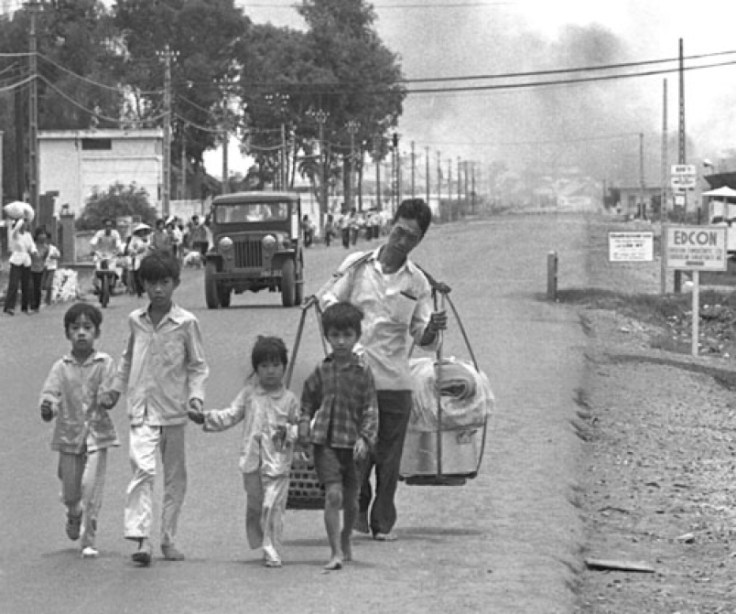
Refugees in Saigon, May 1968 ~ pc Stripes.com

Continue reading “Song of war #3 – Du Mục (The Herd)”

Song of war #4 – Hãy Sống Giùm Tôi (Live for Me)

It is not easy at all to choose a couple of songs from Trịnh Công Sơn for any list of ten songs about the Vietnam War.   The first of his five albums in the Sing for the Vietnamese Country series – Hát Cho Quê Hương Việt Nam – is a masterpiece that must be listened from top to bottom.  It is not a surprise that both of my selections come from that album.

2723643

Hãy Sống Giùm TôiLive for Me or Please Live For Me – is perhaps the simplest composition in the entire album: musically, perhaps; linguistically, definitely.  It took me, what, all of six or seven minutes to translate the lyrics – half of the time on two or three lines.

KEEP READING!

Blog at WordPress.com.

Up ↑