There are different ways to build a top-ten list. The way I employed for this list is twofold: pick the top song, then poke around to see if I could build a sensible list leading to this song. When I first thought of this list, I knew right away which song I’ll put at the top. My decision was pretty firm. It grew firmer when I made an important discovery that, as far as I know, has never been made by anyone before.
Belief in God tends to be strong for people living amid warfare. It is hardly a surprise then that prayer finds its way into music written during war. It was surely the case with popular music in South Vietnam.
Since this is the week of Christmas, it is worth mentioning that one the most popular South Vietnamese albums is filled with prayer. It is the third album of the fine series Sơn Ca (Birdsong), and the title is simply Giáng Sinh: Tình Yêu và Hòa Bình: Christmas: Love and Peace. It features some of the biggest names in the Saigon music scene at the time: Thái Thanh, Khánh Ly, Thanh Lan, Giao Linh, Lệ Thu, Anh Khoa, etc. (A recording from Elvis Phương would have completed this A-list.)
It is not easy at all to choose a couple of songs from Trịnh Công Sơn for any list of ten songs about the Vietnam War. The first of his five albums in the Sing for the Vietnamese Country series – Hát Cho Quê Hương Việt Nam – is a masterpiece that must be listened from top to bottom. It is not a surprise that both of my selections come from that album.
Hãy Sống Giùm Tôi – Live for Me or Please Live For Me – is perhaps the simplest composition in the entire album: musically, perhaps; linguistically, definitely. It took me, what, all of six or seven minutes to translate the lyrics – half of the time on two or three lines.
“As nearly the same time as the discovery of alcohol,” writes Fernand Braudel in the first of his three-volume work on capitalism from the fifteenth to the eighteenth century,
Europe, at the centre of the innovations of the world, discovered three new drinks, stimulants, and tonics: coffee, tea, and chocolate. All three came from abroad: coffee was Arab (originally Ethiopian); tea, Chinese; chocolate, Mexican.
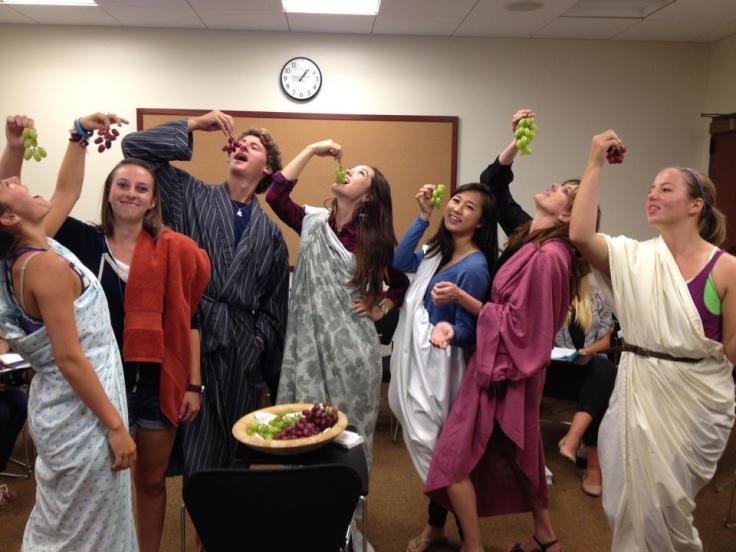
This two-part reflection was inspired by my Great Books classes in the last two years, and by this photo from my Pepperdine colleague Donna Plank. Norman Rockwell’s classic illustration “Freedom From Want,” which I showed in the American history survey class last week, reminded me to finish these posts before Thanksgiving. Gobble gobble!
Donna Nofziger Plank’s first-year seminar Faith & Reason, Fall 2012 ~ Students take a break from discussing Plato’s Symposium. Later they would have pears when discussing Augustine’s Confessions.
The toughest choice for me is the fifth one. It didn’t take me long to settle on the songs above – or the fourth, third, second, and top songs. (Two of the top five belong to Trịnh Công Sơn; can you guess which songs?) For the fifth spot, I wanted to continue on the theme of romantic love and loss from selection #6. I thought of several possibilities.
Grading and other obligations kept me from watching this documentary when it was first shown on PBS last week. But I read the written narrative on the ProPublica website (which isn’t a transcript of the documentary but shares the same materials), and finally watched the documentary online last night. Here are some thoughts after watching it.
On the second day of his visit to the U.S., Pope Francis stopped his motorcade and picked up a five-year-old Mexican American girl who tried to give him a letter and T-shirt. Seeing it in evening news reminded me of another pontiff that visited a refugee camp and picked up a little girl from the ground. It was John Paul II at the Phanat Nikhom Refugee Camp during his papal visit to Thailand in May 1984.
At the time, Phanat Nikhom held thousands of refugees from Cambodia, Laos, and Vietnam. Among the Vietnamese were “boat people” as well as “land refugees,” that is, they left over land rather than sea. International and media focus on post-1975 Vietnamese refugees was typically on the “boat people.” But there were many that left by other means, including crossing through the land mass of southern Vietnam and Cambodia to reach the borders of Thailand.




You must be logged in to post a comment.