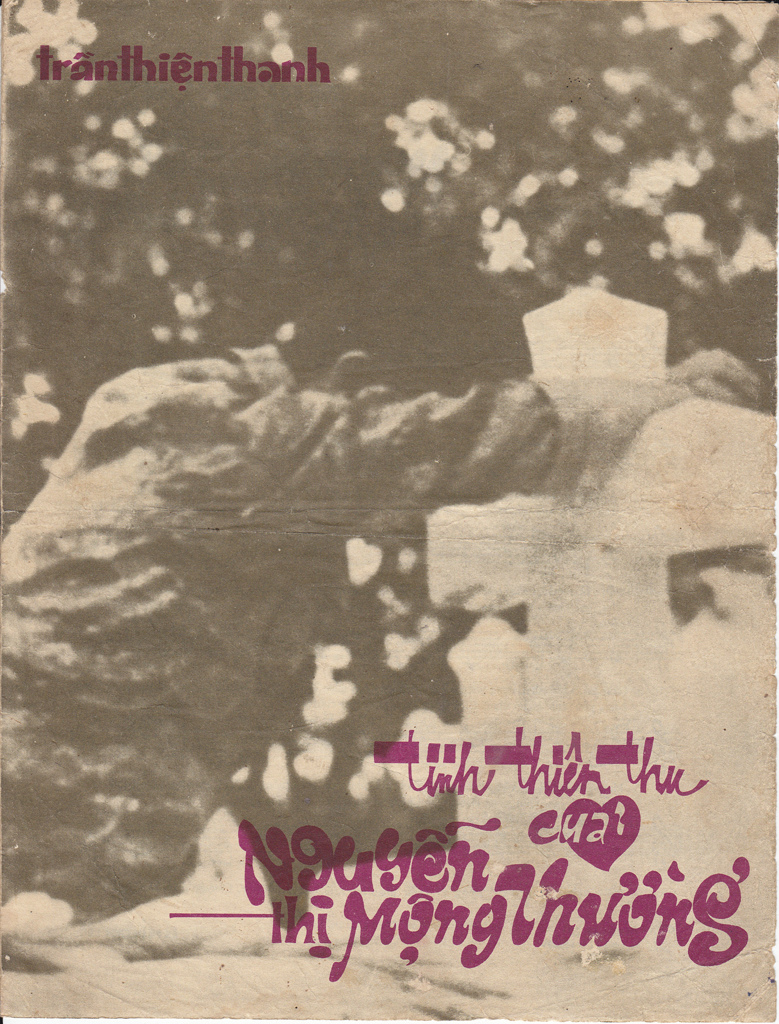
Of the ten songs on this list, this is the only one that tells a story: a true ballad. It is based on a true story, now told in slightly different versions, about two young lovers in South Vietnam: Phạm Tháiand Nguyễn Thị Mộng Thường. Because of its personal nature and the artistry of the lyrics and melody, this ballad has been very popular among Vietnamese. One should always be cautious with comparisons, but I am inclined to think of it as the Vietnamese equivalent of “Where Do I Begin,” the theme song of the movie Love Story that came out two or three years earlier.
Of the eight or nine composers in this compilation of mine – I’m still debating between two songs by two different authors – Vĩnh Điện is by far the least known. An officer in the South Vietnamese military, he was, I believe, many years younger than the other songwriters on my list. [Correction: He was in fact older than Trần Thiện Thanh – see comment below from Jason Gibbs.] His output in the Republican South was modest, as fewer than ten songs were recorded before 1975. My favorite is Vết Thương Sỏi Đá, “The Heavy Wound,” which has to do with the pain of romantic love than suffering from warfare. Check it out, below or from the website that bears its author’s name.
Imprisoned in reeducation camps for many years after the war, Vĩnh Điện came to the U.S. late in life and, out of his searing experience of prison, brought out a lot of new music. Some of these songs were composed in captivity: as the case with poets and songwriters in the same situation, he kept them in his head. Other songs were written in America. They have been recorded in a dozen of CDs, and you can read about them in this write-up of more than 150 pages!
I set out a few basic criteria in the making of this compilation. One is no more than two songs from the same composer. One is to seek a wide variety on style and content. A third is to limit selections to the period of the Second Indochina War. There were many songs written during or shortly after the French War, and I hope to address the connection between the two periods at some point. But ten isn’t a large number by any means, and leaving out music from the First Indochina War hopefully helps to tighten the coherence of the list.
Another criterion is that the selections come from musicians associated in a significant way to the Republican Saigon, thus leaving out music from North Vietnam and the National Liberation Front (NLF). Communist music is worthy of studies for its propaganda value, yes, but possibly more. But it is not included on this list because it diverges too far from music of the Republican South.
A good case can be made for this song to be ranked higher than the ninth spot, maybe even in the top five. But I’m going to keep it in this spot because it provides a sort of continuity from the #10 song, Quê Hương Chiến Tranh or Country At War.
The title means eight urban roads or ways. While nẻo đường is used enough in writing and speaking, it isn’t clear why Hoài Linh, author of the song, chose eight instead of four, six, or nine – all of which have the same accent tone as eight in Vietnamese, which is dấu sắc. In an online analysis last year, Cao Đức Tuấn makes the argument that the phrase tám nẻo đường thành is particular to the city of Saigon. He suggests an association to the old octagonal Citadel of Saigon – Thành Bát Quái – constructed in the late eighteenth century with crucial engineering assistance from French allies to the first Nguyễn emperor Gia Long. The evidence on this particular point is thin. But the larger point that the title refers to Saigon is plausible, if for other pieces of evidence in the lyrics.
Bài lời Việt theo sau bài tiếng Anh. Hai bài hao hao nội dung nhưng không giống hẳn. The Vietnamese portion follows the English. I cater each language to different readers and they aren’t entirely the same.
April 30 was of course the climax of the fortieth anniversary of the end of the Vietnam War and the beginning of mass Vietnamese migration to the U.S. But there’s still a lot of the anniversary year left.
April 30, 2015 in Little Saigon, Orange County
Tomorrow is the first day of classes at my institution, and I will continue to honor this anniversary by posting about Vietnamese music related to war and refugees throughout the fall semester and into the spring semester.
What did the first waves of Vietnamese refugees in America think about themselves? What was their mindset regarding their place in the world? Is it possible to write a coherent literary history of their experience?
Cover of the book under discussion, next to a collection by Thái Tú Hạp published three years later ~ Source: nguoi-viet.com
The search for answers can take different directions and have different starting points. In my opinion, it isn’t a bad idea to begin with a collection of poetry, essays, memoirs, and fiction entitled Tuyển Tập Thơ Văn 90 Tác Giả Việt Nam Hải Ngoại 1975-1981: Selected Poetry and Prose from Ninety Vietnamese Writers Abroad, 1975-1981 (Missouri City, TX: Văn Hữu, 1982).KEEP READING!
To reiterate a point from the last post, nationalism appears here and there in South Vietnamese music, not in one place. Strong arguments will necessarily come from a broad survey of songs, not a few. For now, however, I will zoom in on just one song in the hope of illustrating certain aspects of nationalism in the Republican South.
The band Vì Dân (For the People) in 1959, with Hoài Linh holding the accordion (source: khanhly.net)
What is Ba Lần Mẹ Khóc, whose title I have Englished as Thrice Mother Wept, opting for old-style “thrice” over “three times” in order to cut down on syllables? Like Tuổi Trẻ Chúng Tôi, it was recorded only once in South Vietnam. KEEP READING!
This is the first of two posts on music in South Vietnam. Here is the second post.
The first time at the Association of Asian Studies (AAS), I presented a paper on ethnic nationalism in South Vietnamese music. Thanks to a nice line-up that I put together (including the Australian anthropologist Philip Taylor as chair and discussant) and auspicious scheduling (right after lunch time on Friday and without another panel on Vietnam at the same time), a lot of people in the field showed up to this panel. It seemed, indeed, as if Keith Taylor was the only big name from the U.S. that was missing. (I did see him a few days later at Cornell.) The sizable room was nearly packed: a most desirable outcome for a conference panel anywhere.
Alas, it was a successful outing in most respects but for me. KEEP READING!


 tuannyriver
You must be logged in to post a comment.