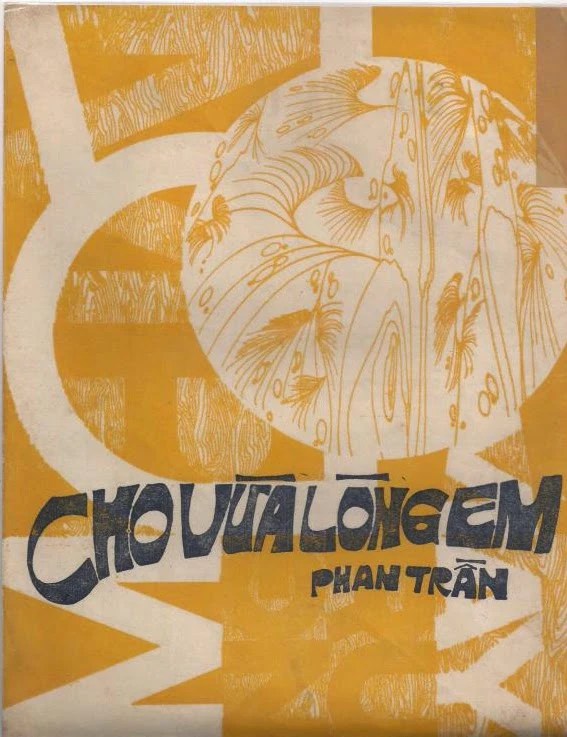
The title of the bolero song Cho vừa lòng em is somewhat odd in the context of the lyrics. It’s not easy to translate this title, and I’ll come back to it below.
The peak of Westernized pop music in twentieth-century Vietnam, approximately from the late 1950s to the mid-1970s, did not merely coincide with warfare and national division. It also coincided with an ongoing shift in sensibilities about marital love: the ideal of affectionate marriage. This ideal was further coupled to the ideal of first love: that first love meant giving completely one’s heart to the other person, that first love should be the foundation of marriage.
The ideal, however, was often frustrated by other factors, including parental pressure, approval, and disapproval. Losing first love happened as easily as gaining it. There wasn’t such a thing as “second love” because it wouldn’t be love. One might end up marrying someone who wasn’t one’s first love, but it would be simply marriage rather than marriage based on affection. The loss of one’s first love would be devastating.
All right, I should qualify right now that there isn’t clear evidence from the lyrics that this song is about the loss of first love. But there is plenty of evidence from other sources that the loss of first love was the hardest and one that evoked the most intense feelings. You just have to trust me on this one for now.
The entire song is about the pain of having lost one’s love. The opening verse gets right to the devastation of parting.
Thôi rồi ta đã xa nhau, kể từ đêm pháo đỏ rượu hồng,
Anh đường anh em đường em, yêu thương xưa chỉ còn âm thầm.
Em đành quên cả sao em, kỷ niệm xưa sánh như biển lớn?
Ân tình cao tựa bằng non, chỉ đổi bằng nhung lụa sao người?
We’ve gone our ways since that night of wine and firecrackers,
I go my way; you yours: our old love is left in silence.
How could you forget our memories that were like the sea?
Our love was as high as the mountain and now it is traded for wealth?
The second verse shows the extremity of his action.
Anh về gom lại thư em cả ngàn trang giấy mỏng xanh màu,
Gom cả áo lạnh ngày xưa anh đem ra đốt thành tro tàn.
Cho người xưa khỏi phân vân khi ngồi đan áo cho người mới.
Khi mùa đông lạnh lùng sang, em khỏi nhớ chuyện ngày xưa.
I gathered your letters, some thousand of thin, light-blue pages,
Even the old sweater [that you knitted] and burned all into ashes.
You won’t be torn when you knit another for your new love,
You won’t think about the past when the cold winter arrives.
In contrast to the crowded lyrics of the verses, the words in the refrain are expectedly spread out and many of the notes linger.
Em ơi hết rồi, hết rồi, chẳng còn chi nữa đâu em!
Yêu thương như nước trôi qua cầu,
Như đàn trở phiếm cung sầu,
Còn gì nữa đâu?
My dear, it has ended and there remains nothing anymore!
Love is like water under the bridge,
Like a guitar playing a sad tune,
What is left?
The last verse is consisted of three resolutions: two vows and one declaration, all intense. I will not love anymore. I will not believe in love anymore. And I hate myself for having given all my love to the person who left me.
Tôi thề tôi chẳng yêu ai vì người ta cứ phụ tôi hoài!
Bây giờ tôi chẳng còn tin trong nhân gian có kẻ chung tình!
Tôi giận tôi đã ngây thơ đem tình yêu hiến dâng người hết,
Nên giờ tôi chẳng còn chi khi người ngoảnh mặt mà đi!
I swear to love no one else ever because they would fail me!
I no longer believe that there is anyone faithful in this world!
I’m angry at myself for having given all my love away,
Leaving me with nothing when my love turns away from me!
Near the end of The Portrait of a Lady, Henry James describes a conversation between Isabel Archer, the novel’s protagonist, and a minor character called Mrs. Touchett. The older woman informed the younger American woman that Lord Warburton, an English aristocrat who was deeply in love with Isabel but she turned him down, had a short courtship with someone else and was now engaged to be married. “And,” asked Isabel, “who’s the young lady?” “A member of the aristocracy,” responded Mrs. Touchett, “Lady Flora, Lady Felicia – something of that sort.” In the introduction of the Penguin Classics edition of the novel, the scholar Geoffrey Moore offers a succinct comment: “These are but substitutes; [Warburton] will always be in love with Isabel.”
Notwithstanding the oath and determination to forget, the youthful speaker in this bolero song will always be in love with the young woman he has lost.
Cho vừa lòng em was initially drafted by Mặc Thế Nhân under the pen name Phan Trần. He then sought the assistance of Nhật Ngân for a revision. How should its title be Englished? At the most literal level, it could be called To please your heart or Pleasing your heart. It is clearly an ironic title: the pain and anguish of the young man is elevated as if it was sacrifice for the heart of the woman. Yet, the irony may also suggest that ideal of first love: that it should be the only romantic love in one’s life whether or not one would end up with the object of that love. Perhaps it should be translated more loosely as Pleasing your heart by destroying mine.
Maybe because of its emotional intensity, this song has been quite popular both before and after 1975. The best-known recording from the Republic of Vietnam is from Chế Linh. It starts with a lyrical guitar introduction then moves into an eight-beat rhythm of clack-clack-clack-clack-pause-clack-pause-clack-pause from the dry sound of two claves. Its pace is quite slow, which in turn leads Chế Linh to sing as if enunciating the syllables. And he enunciates them lovingly. Even if you don’t know Vietnamese, listen to his voice and enunciation and you may very well feel some of the innermost anguish of the lyrics. In my opinion, this recording is one of Chế Linh’s finest achievements.
Recordings have tended to come from men. This video of Duy Mạnh’s performance in Vietnam was posted in 2017 and has racked up over 26 million views by 2025.
This version, sung by Hoài Lâm for the series Paris By Night, is different from all recordings featured in this post. Why? Because its arrangements are very jazzed up.
Women have also sung this song, possibly more often in live performances than recordings. Tâm Đoan did both in this video for the series Paris By Night.
This song is also apt for duets, and this version by Như Quỳnh and Thế Sơn for Paris By Night opts for minimal instrumentation, even sparse, consisting of an acoustic guitar and a violin. Perhaps as a tribute to the Chế Linh recording, it adopts a similar slow and rhythm albeit with the guitar instead of claves. The show’s writers and directors added a few speaking lines for Như Quỳnh during the instrumental break (and a few words at the very end). They are poignantly spoken, but also make one wonder why Thế Sơn isn’t given any spoken words.
Richer is the instrumentation of another duet: this from Lệ Quyên and Quang Lê and in recorded in Vietnam. It is indeed a delight to listen to the instrumentation, one of the best in recent recordings of bolero songs. During the first verse, the percussion instrumentation cleverly pays tribute to the classic rhythm of the verses by skipping the second beat. The instrumental break is the only portion that could be fuller. On the other hand, it is nicely led by the sound of a đàn bầu (gourd zither). Lastly, the voices are very well matched, making for a generally well-made recording.
And here’s a studio recording if you’d like to listen to only Lệ Quyên’s voice.
A more recent recording is from Hoàng Hải. Aside from her performance, I find this comment by a Vietnamese man to be very interesting: Làm tôi nhớ cuộc tình đầu thời trai trẻ vậy mà đã mấy chục năm rồi: It makes me remember the first love of my youth, already several decades ago. Ah, first love.
 tuannyriver
2 Pingback