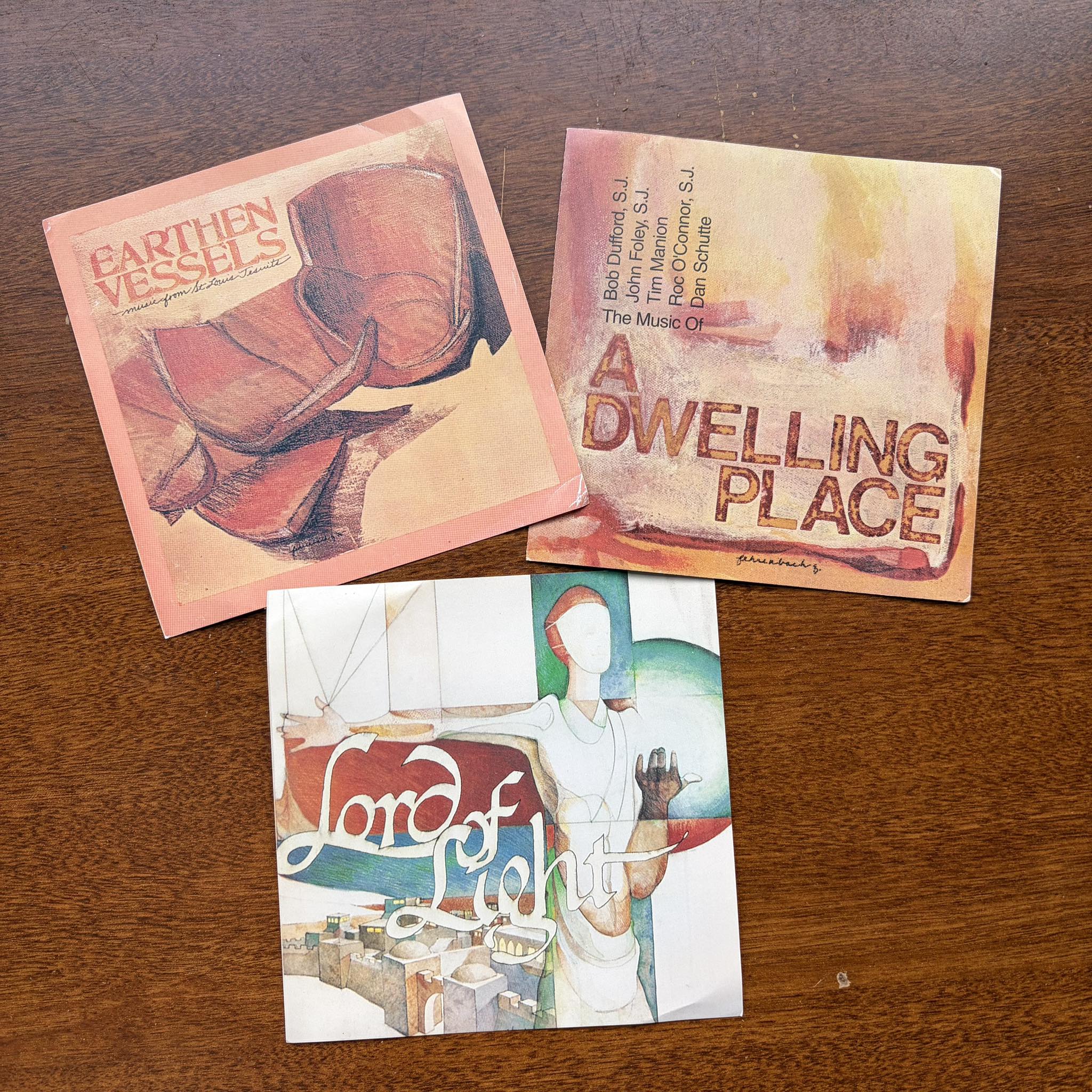
Whatwith my preoccupation with the 50th anniversary of the fall of Saigon, I completely forgot the same anniversary of the album Earthen Vessels (1975). It wasn’t the first album of the St. Louis Jesuits, but it was their very best alongside the next album, A Dwelling Place (1976), whose semicentennial is this year.
Their first album, Neither Silver Nor Gold (1974), includes a couple of bona fide classics: “Sing a New Song” and “You Are Near.” The former is still sung at masses: as perfectly a piano-based congregational hymn as any other that came out of this era. The latter makes for a good solo or duo. Several others–“Before the Sun Burned Bright,” Come with Me into the Field,” “Father, Mercy,” and “For You Are My God”–were promising but didn’t make the same impact on congregational singing. Still, they are great for listening and singing on one’s own.
The promise of Neither Silver Nor Gold was delivered with Earthen Vessels and A Dwelling Place. Just count the hymns from these albums that proved influential in American Catholicism and beyond. “Be Not Afraid.” “Blest Be the Lord.” “I Lift Up My Soul.” “Like a Shepherd.” “Peace Prayer.” “Praise the Lord My Soul.” “Sing to the Mountain.” “Take Lord Receive.” “Though the Mountain May Fall.” And, of course, “Glory and Praise to Our Lord” that nick-named the new style of that era.
Other songs in these albums might not be sung often at Sunday masses today, but most have proven durable over the decades and are still sung occasionally. “Behold the Wood.” “Only in God.” “Trust in the Lord.” “What You Hear in the Dark.” I also have a soft spot for the title songs. The lyrics are quietly affirming, as heard from the second verse of “Earthen Vessels”: “He has chosen the lowly / Who are small in this world.” Or at the start of the chorus of “A Dwelling Place”: “May Christ find a dwelling place of faith in our hearts / May our lives be rooted in love, rooted in love.”
The group released several more albums, notably Lord of Light (1981) that yielded at least two more classics in “City of God” and “Here I Am, Lord.” This album is distinct because more than half of its ten songs are slow in tempo and meditative in intent: “Answer When I Call,” “Jesus the Lord,” “May We Praise You,” “Only This I Want,” “Redeemer Lord,” and “This Alone.” It is worth considering this album alongside Earthen Vessels and A Dwelling Place.
That said, I think it’s fair to say that there were no greater heights than the albums from 1975 and 1976. While those hymns were accompanied by the acoustic guitar (and still are), they have also been rearranged for accompaniment by the organ.
I was fortunate to have grown up in two liturgical eras: postcolonial Vietnamese and postconciliar North American. It was indeed over a recent conversation on Catholic music in South Vietnam during the late 1960s and early 1970s that reminded me of the anniversaries of these two albums. Though different, those traditions were common in drawing lyrics directly from the Bible, especially the Psalms and the Gospels. It was a shift from the heavily devotional contents of the older hymns rooted in nineteenth-century ultramontanism.
The Second Vatican Council played a major role in ushering in the spirit leading to this kind of music. Traditionalists were averse to it while reformers welcomed it. As noted in this article, liturgical warfare was large in the years following the Council. In any event, composers of the glory-and-praise music found inspiration in the Word of God and in turn emphasized the love of God and the celebration of the kingdom.
When I arrived to American shores in the early 1980s, the hymns of the St. Louis Jesuits were well integrated into the liturgical life of the US Church. They even made the way into certain traditionalist circles, if selectively. In the late 1980s, I even heard “Glory and Praise to Our Lord” being sung by members of the Legionaries of Christ during a liturgy at their American headquarters in Connecticut. Of course there could be no guitar accompaniment, and it was sung a capella. Even there, it was somewhat astounding in retrospect that a St. Louis Jesuits song was sung by members of this ultra-conservative men’s religious order.
By the late 1990s, the albums were readily available on CDs. I purchased both (plus Lord of Light) at a Catholic store in Seattle and listened to them many times. (By the way, the details on A Dwelling Place listed “graphic design” by Vu Le: apparently a Vietnamese working for OCP Publications.) For the first time in years, I recently listened to each from top to bottom, this time on YouTube, and, again, found them very well put together.
Many of these songs are still sung at liturgy today, and across the globe. I searched for mass singing of a few titles on YouTube, and, surprisingly, videos that popped up the most came from Catholics in Singapore and Filipino Catholics living and working in Dubai.
Bob Dufford, John Foley, Dan Schutte, Tim Manion, and Roc O’Connor weren’t the only creators of postconciliar hymns. But their works, especially in these albums, have served God and the faithful. Well done!
 tuannyriver
Leave a comment