
At about 8:30 PM on October 17, a Tuesday, four undergraduates at my institution were killed in an auto accident four miles from campus.
Wednesday October 18
6:00 AM. I normally get to campus at this time, but today I leave the house ten minutes later and am still on the Pacific Coast Highway (PCH). Shortly after passing Duke’s, probably the best-known full-service restaurant in Malibu, the road was closed and vehicles were rerouted on the Rambla Vista. The reroute was steady and quick on my end, but it was bound to be very slow as more vehicles get on the road on both sides.
From past experience, I could tell that something very bad had happened, possibly deadly. A year ago, on October 22, 2022, I was rerouted at the Carbon Canyon Road, 3.5 miles from campus, for a very long detour because it was a very windy road. I got lost at one point and ended up at some picturesque top of the mountains before getting on the Malibu Canyon Road. It turned out that there was an overnight single-car crash into a utility pole. There was no fatality but they had to close the road to restore power.
A year before this accident, however, an automobile struck and killed a pedestrian around six in the morning. It was a Friday (September 17, 2021), which I normally worked from home, but I was aware that this death took place near the corner of Carbon Mesa Road, which is close to the utility pole accident and half a mile from the accident that killed the Pepperdine students.
6:37 AM. An email informs the campus community of a fatal accident and that “Pepperdine students may have involved.”
8:30 AM. Divisional meeting: this semester’s third and last one. The division dean gives an update that there were four deaths, all women. There were also two persons that were seriously injured and hospitalized, but it’s not clear if they are Pepperdine students.
8:40 AM. Another email: “the University has reason to believe the four individuals who were killed on Pacific Coast Highway were Seaver College students.” For the rest of the day, this line and the line from 6:37 AM would be quoted in countless news reports. Some name “Seaver College,” even “Seaver College of Liberal Arts,” in addition to Pepperdine. It had rarely happened in national and even regional news reports before, and I must admit that it feels slightly strange to see “Seaver College” in national and international news.
10:45 AM. An update that includes announcements of gatherings for communal prayer and reflection. In addition: “While we understand there are names circulating on social media and in our community, Pepperdine does not share names without official confirmation, which we do not yet have from local authorities.”
11:30 AM. My office suite hosts a faculty meeting: part of a series on pedagogy. A catered lunch arrives, and I go to the cafeteria to get some ice for drinks. An English faculty leads the meeting and begins by asking for one word about where each of us are. The most common is sad. We goes through the prepared materials, but the conversation also shifts to the classroom in the next couple of days. There are many thoughts and ideas.
1:30 PM. Alone in my office, I think back to a conversation in the same room six or seven years ago. I listened to the grief of student, now an alum of the Class of 2019, about the death of a student that she worked with at the same campus office. It was a stand-alone car crash that took place on a freeway during a weekend in early 2018. There was a spectrum of grief then, the student’s obviously more than mine; and there’s a spectrum of grief now.
3:09 PM. A pizza party tomorrow had been planned for Great Books students and faculty. Having checked in with my colleagues who rightly wanted to postpone the party, I email students to inform of the cancellation. I add that I’ve kept thinking of Book 4 of Confessions, the passages about Augustine’s childhood friend (and unnamed), and the grief he felt after the death of this friend.
I also think of the Borderline shooting, whose fifth anniversary is coming up exactly three weeks from the day the fours students were killed.
4:52 PM. Besides the official University emails, emails have come from the Seaver Dean, the president of the Seaver Faculty Association, and the University President. Now comes an announcement from the VP for Students Affairs. “Seaveer College students, seniors Niamh Rolston, Peyton Stewart, Asha Weir, and Deslyn Williams, passed away in the car accident on Pacific Coast Highway last night.” I immediate recognize one of them. Also, “Each departed student brought a unique gift and spirit to the University, and we deeply grieve [their] unfulfilled hopes and aspirations.”
4:58 PM. I email the class that meets tomorrow at 8am: “I’m not yet sure how it’s going to be like, or even how to start it. But it will start differently than usual.” I’d email a similar message to the other class, which meets in the afternoon.
5:00 PM. In Fall 2020, Peyton Stewart was a brand new college student and was assigned to my section of HUM 111. It was the only semester completely on Zoom. I find her essays and reread one of them. I look again at her fun assignments: funny (fake) Twitter accounts about the Iliad and the letters of St. Clare of Assissi.
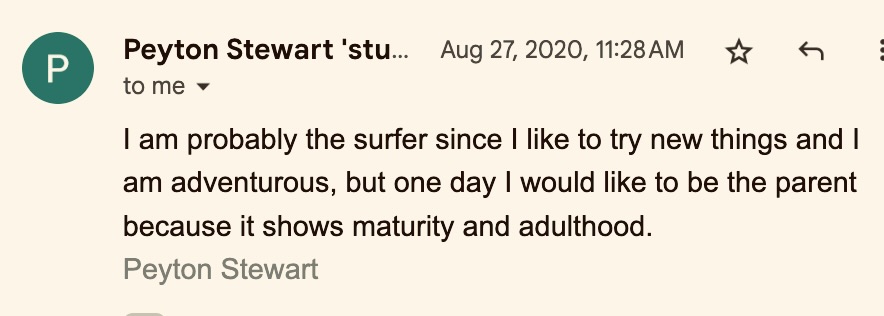
At the end of the first class meeting, I played the following video as an icebreaker and asked students to send me their choices (which were collected and sent to the class.) I searched among the emails and found Peyton’s response: I am probably the surfer since I like to try new things and I am adventurous, but one day I would like to be the parent because it shows maturity and adulthood.
It’s heartbreaking. It’s beyond sadness.
Between 4:00 PM and 7:00. I’d scheduled late office hours for today, and several students already signed up to see me. One said that she had a class with one of the four women, and they usually sat close to one another. Another has belonged to the same sorority as all four, Alpha Phi. They’d signed up to discuss writing an essay about Rousseau, but the situation turns it into a time of grief and mourning.
Borderline was horrifying. But I think there’s a difference in that there are four dead students this time in comparison to one (along a dozen of other people not affiliated to Pepperdine). I don’t know how the differences are playing out, but my intuition is that the impact on students, faculty, and staff will be even weightier this time. As if, of course, it wasn’t weighty enough five years ago.
Thursday October 19
3:00 AM. Even though I am a strongly morning person, I wake up earlier than usual.
During my years of living in L’Arche Seattle, I sometimes spent time at Nestucca Santuary, a retreat center in the Oregon Coast and owned by the Jesuits of the Oregon Region. Andy Duffner, Jesuit priest and physicist, ran it for years along with Colleen Dean. I’d be there for one week to three. During one of my times there, a young woman came for a weekend and learned that I went to Saint Mary’s University of Minnesota. She informed me that she heard on the radio that five students at my alma mater died of drowning after a single-vehicle auto crash. (It turned out to be three students and two recent alums.)
It was very sad to hear the news back then, but it is infinitely sadder this time.
4:45 AM. As if making up for yesterday’s late start, I came to campus a little earlier than usual. I decide to put on a suit for the day.
5:45 AM. A stop at the Starbucks in the Malibu Colony Plaza across the road from campus. I don’t always get a cappuccino in the morning, as a regular cup of coffee is fine. But I need something stronger this morning.
7:00 AM. I normally begin a Great Books meeting by asking a student to read aloud a short poem or prayer that I select from one of the prayer and reflection books on my bookshelves. I’d like to “mark” the time in class to stand apart from the rest of the day. Today, however, I decide not to do that because it is, alas, too different.
8:00 AM. Fourteen students out of sixteen come to class, including two discussion leaders who had sent me their discussion questions. This discussion would be on the last third of Candide. It’s one of my favorite assignments for a class discussion in this course. The others include Acts 4-5 of Tartuffe, Book 9 of Paradise Lost, and the last portion of Book 1 of Persuasion.
I say that for today, we go around three times and they are free to share or not share at all.
Borrowing yesterday’s faculty experience, the first round is, “What’s one word to tell where you are?” One or two students say numb. One or two say sad. Mine is sorrowful. The most common by far is heartbreaking/heartbroken.
The third question: On the scale of zero to ten, zero being having no energy whatsoever and ten having an enomous amount, where are you? Two or three students are above five. The vast majority say three.
In between, the second question take the longest to go around. Describe your relationship with any of the women that were killed, and your thoughts and feelings about them. Some say a lot; some say little. One says a few words then is compelled to leave the room for five minutes. Another student follows her.
Back to November 2018, a colleague in English wrote the following on FB: The news came in during class that Pepperdine student Alaina Housley was killed in the Thousand Oaks shooting. I did not know what to say. They did not know what to say. We wept.
In this case, we had a little more time to absorb the news. All the same, we weep.
I tell students that we’re going reschedule the discussion to the next class. I speak about a few other things then dismiss class at exactly 9am. One student stays behind and we talk about his plan to write the next essay on Voltaire.
10:00 AM. I walk with a colleague in the same division to the Fieldhouse for prayer service. We climb up and sit on the bleachers. As we wait for the service to begin, I realize that this is the second time that I’ve sat on the bleachers. The first time was the memorial service for Alaina Housley nearly five years ago.
It is a simpler and shorter service this time, and a little smaller in attendance. But not small, and I see many familiar faces among faculty and staff and of course students. The speakers include the VP for student affairs, the provost, and of course the university president. The president of student government reads a number of brief passages from the Bible. A faculty in voice closes the gathering with a song unaccompanied by instruments. We leave in relative silence.
Except for the speakers, it is in fact quite silent for the first third of the event. It changes, however, when the provost announces that the deceased would receive their degrees posthumously, as they “are qualified to receive this honor in the Class of 2024.” Upon “Class of 2024,” several people sobbed, probably friends and members of this Class themselves. The sobs continue on-and-off for the rest of the event.
They sob, I think, for the rest of us that are sobbing inside.
11:30 AM. As usual on Thursdays, I go to faculty lounge for lunch. All tables are bunched up together this time, and many faculty come and go. We speak only a little about the deaths of the students, maybe because we have already and will continue to talk about them.
2:00 PM. I indeed talk about them again in my afternoon class. I follow a similar script like the morning. It is smaller than the morning class, and it becomes even smaller because three had emailed me and asked to be excused. Yet we spend more time talking, perhaps because all except one student will graduate next spring. After dismissal, a student and I keep talking for fifteen minutes. Then a friend of hers (whom I know) walks by and three of us talk for another ten minutes. This student is in student government and scheduled to speak at the candlelight vigil in the evening.

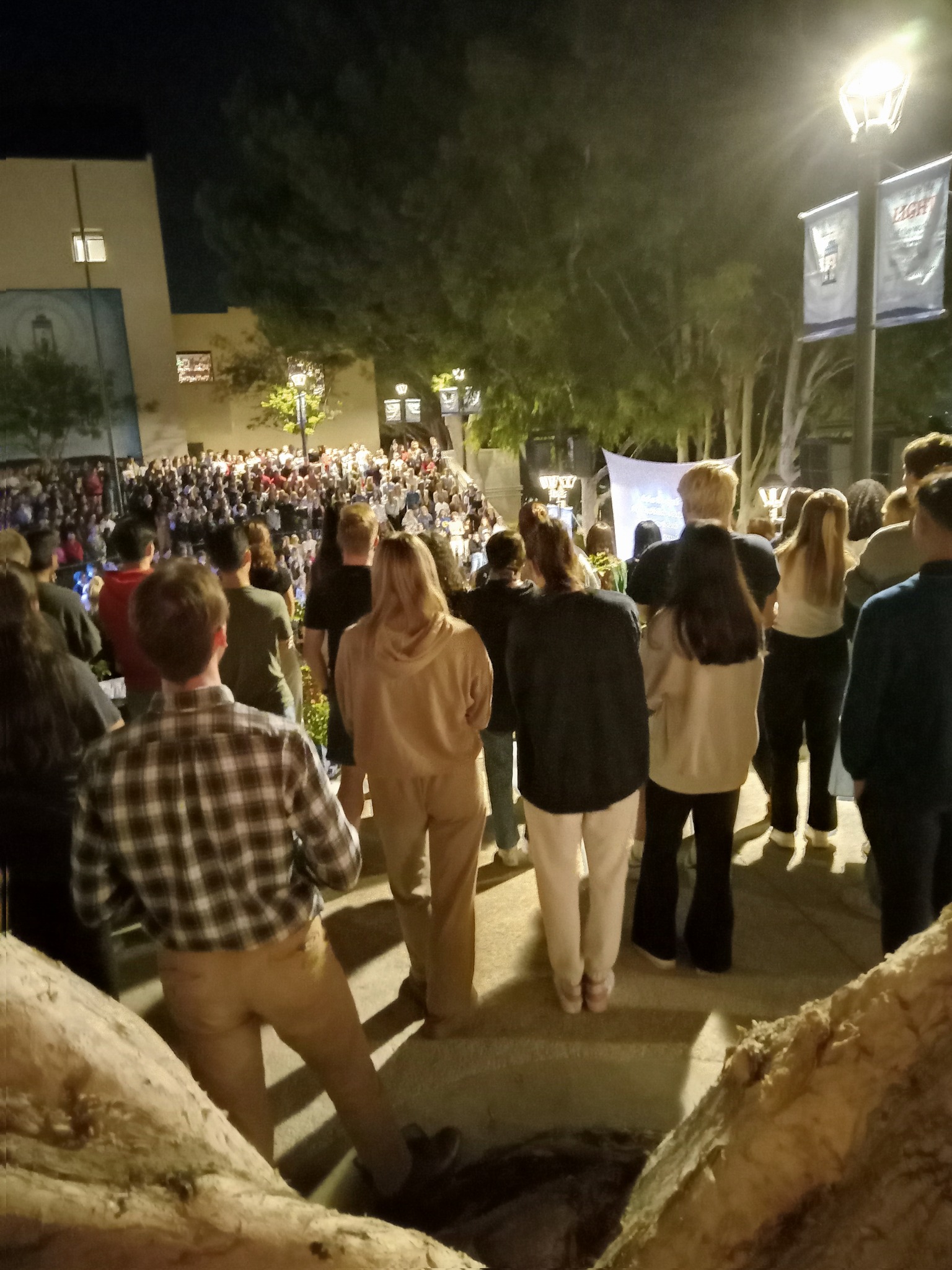
8:00 PM. I put my stuff in the car and walk to the amphitheater for the candlelight. The night before, a weekly worship event was turned into a prayer service for the deceased, and students had told me that it was the biggest they’ve seen of this event. The candlelight service may be a touch bigger.
Two weeks before, a colleague in English invited the university chaplain, a Great Books fellow faculty, and me to his first-year seminar to share our experiences on the theme of vocation. At one point, the chaplain spoke about her role, which sometimes included ministering to unexpected deaths. I thought of (and told her) that I was at last year’s candlelight prayer for a student that died upon returning from spring break, and I remember how important her presence was that evening.
Alas, here we are again. Someone sings. Someone speaks. Someone reads from Scriptures. Then the aforementioned student speaks. Then the chaplain speaks. There aren’t enough candlelights, and she asks others to use their cell phones.
A student stands near me and we give each other a hug. I walk to the other side to take a photo and run into two other students. As the chaplain gives the sermon, her husband stands in the back and gently rocks their grandson. I go up to the second floor of the library and take a few photos. It might be the only time ever that I was on the second floor at 8:45 in the morning and 8:45 at night on the same day.

Friday October 20
6:00 AM. I don’t have classes today, but what is it like for colleagues who do? At the pedagogy meeting, the consensus was that for many students, Friday may be harder than Thursday. I don’t remember why we thought so, but it must have come from our collective experience.
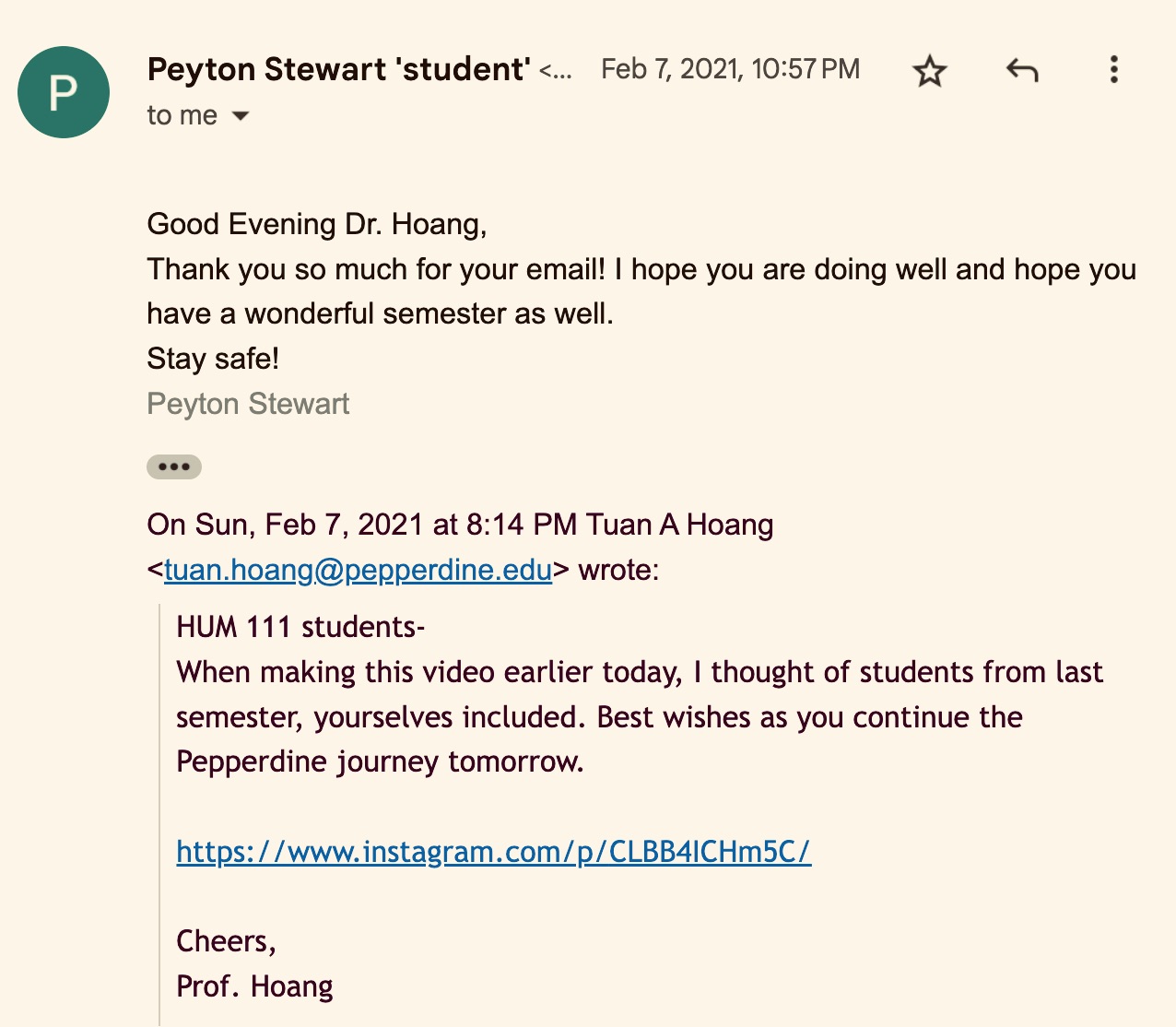
In the meantime, I go back one more time to my emails with Peyton. Most were questions about an essay or another assignment. One was about the likelihood of missing the next class because of a house inspection and the difficulty of finding another place with wifi. (Remember how few businesses with free wifi were around during the pandemic?) Then after that semester, I made a funny video about Zoom classes set to Dua Lipa’s Don’t Start Now. I sent it to students in that class and wished them luck with the new semester. Some students emailed back, Peyton among them. She wrote: Thank you so much for your email! I hope you are doing well and hope you have a wonderful semester as well. Stay safe!
“Stay safe!” It’s heartbreaking and beyond sadness, again.
 tuannyriver
Leave a comment