I didn’t think a lot about the uses and misuses of AI during 2024-2025, but they were somewhat in the back of my mind. Then a month ago, I decided to use AI (mostly ChatGPT) in my classes during this semester (mostly Great Books I with first-year students). I am happy to report that so far, it has gone well enough.
My employment of ChatGPT has been pretty limited. This fact alone is hardly a surprise because the newness of AI in academia has created a vast spectrum in application, everywhere from outright prohibition to eager requirement.
In any event, my starting point isn’t about writing, which tends to generate the loudest conversations and biggest concerns (usually on cheating but also somewhat on students “not being able to write anymore”). Those concerns are legitimate. But my experience is that good writing isn’t possible without good reading. Even as AI is altering how people read and write, I think that reading and writing will continue to be closely related in the future.
At this point, my usage of ChatGPT is for reading and class discussion.
I already created an account of ChatGPT two years ago, but like Facebook and Instagram, I didn’t start using it until much later (which was, again, a month ago). So far, I liked it a lot.
Why? Because it generates outlines, comparisons, tables, and various things (often in bullet points that are visually easier to follow): the sorts of things that I’d normally spend some time explaining to students. Now, I spend much less time on that and, conversely, more time on helping them analyze a specific passage, episode, topic, theme, character, etc. Breadth isn’t unimportant at all, but I’ve always wanted students to seek depth in their thinking. Long before AI, I’d designed different tools and different ways to reach that goal. Now, I count ChatGTP among those tools. It is admittedly a much more powerful tool.
Judging from class discussion so far, I found that it’s helped in reaching the goals of depth and analysis.
Here’s an example.
On August 19, the class met for the first time.
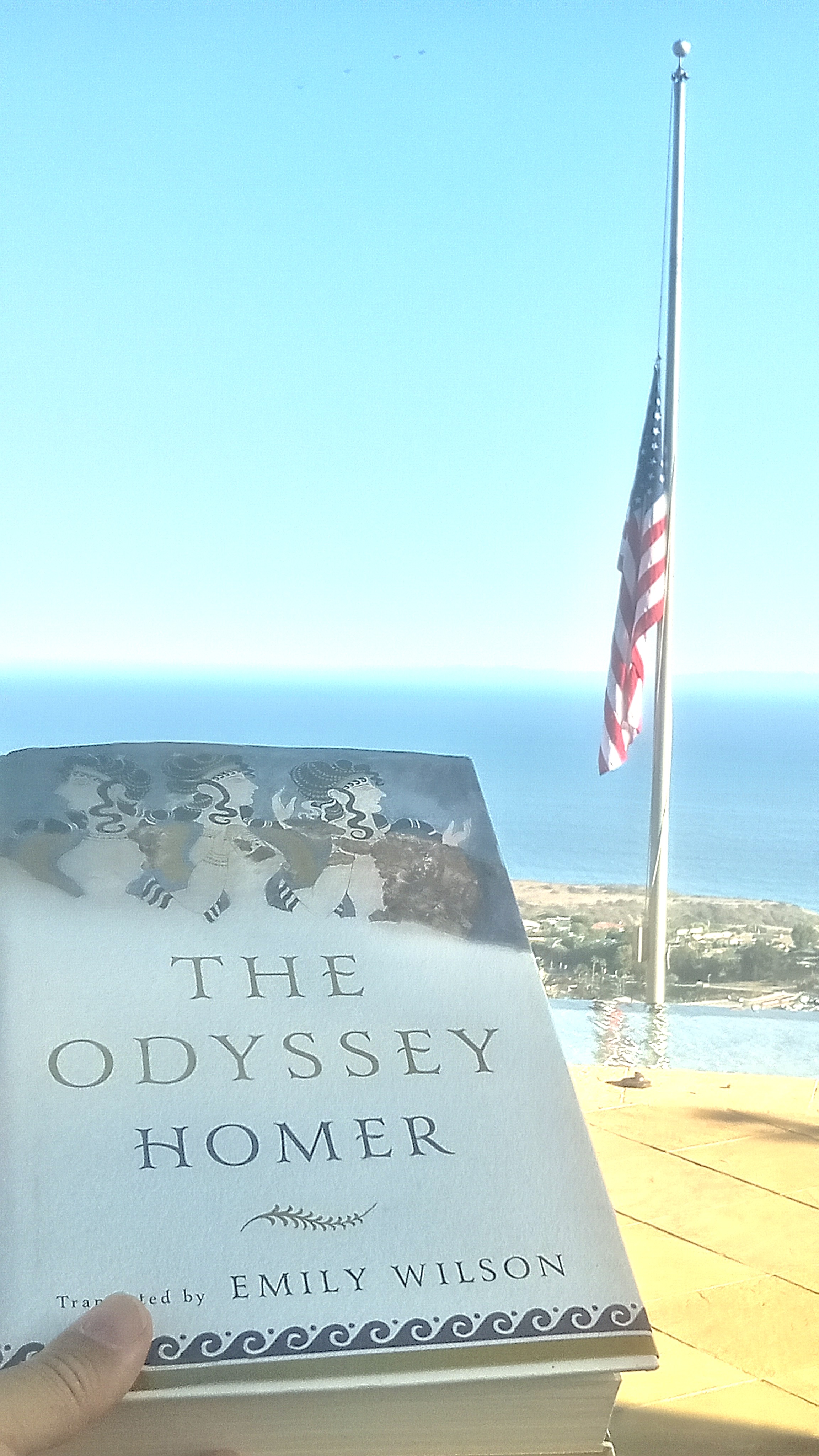
- We went over the syllabus, took a break, and had a discussion of the first four books of the Odyssey. We examined the opening and discussed what Emily Wilson’s translation of Odysseus as “a complicated man” might mean. We also discussed the ethics of xenia, especially Book 4, when Menelaus welcomed Telemachus into his palace.
The next class was on August 22, and I did the following. During the first half of the class, I asked students to get their laptops then emailed them this link that I’d generated.
- I asked students to take a look at the table at the bottom of the link. I told them that in my days as a college student, you could find a similar outline or summary by purchasing a copy of Cliff Notes on the Odyssey. It was obviously more time-consuming, but finding summaries is hardly novel. When we entered the Internet Age, a student could easily find a similar outline on numerous websites. It’s the same with ChatGPT, except that it’s exceedingly fast–and the lists and tables are even better organized and presented now.
- Moreover, at the end of the response to the first question in this link, ChatGPT offered me an option to read a summary or a scene-by-scene outline. I chose “scene-by-scene” and, voila, something similar to Cliff Notes back then but probably a touch better.
- I asked them to go back to Book 4, this time focusing on Scenes 2 and 3 as they are listed on the ChatGPT link above. I asked them to reread (or read) a passage encompassing those scenes in silence and with the following point in mind. There’s a lot of weeping and tears in Book 4, even in this passage alone. Why?
- It launched a class discussion about Menelaus’ sorrow over the presumed death of Odysseus. Menelaus’ speech prompted Telemachus to cry, and they discussed those tears as well. It was a pretty good discussion. Not surprisingly, several students spoke the most–four out of 18–but others too. Only a handful of students didn’t say anything during this portion.
Next, I emailed this link about Book 5. Again, the top list organizes this chapter into scenes, eight in total. A student said that she really liked this division because it handily broke down the sequence in this chapter “like a play.” (Funny, there are four Theater majors in this class and this student wasn’t one of them.)
- I told students to scroll below the outline for the themes. I said that to tackle all those themes, we’d need three classes rather than just one. By necessity, we’d need to be choosy on how to spend class time. Since I am in charge, I said, we will focus on (a) Calypso’s response to Hermes at the end of Scene 2 and then (b) all of Scene 3.
- I asked them to go over Calypso’s response in silence. I said there isn’t one way to interpret her response, but a prominent interpretation is feminist. After two minutes of reading in silence, I said that if I had asked ChatGPT to explain this passage from a feminist perspective, I’m sure it would have given a solid response. But how about you guys? It’s your view that I want to hear. If you’d take a feminist perspective, how would you interpret it? If you take another perspective, what would you point out from this passage to support it?
- Not surprisingly, the longest responses came from a couple of young women. (There were 13 women and 5 men.) But others spoke too. The discussion wasn’t limited to feminist interpretations, as several advanced the thesis of Calypso as a sacrificial person.
- We then moved to Scene 3, where the discussion hit a peak. This is the third time I teach the Odyssey and we always discussed this scene. From what I could recall, this class probably gave the strongest discussion of the scene. By the end of the first hour, everyone but two students had spoken.
It is, again, too early to know the outcome. But I can say for sure that at worst, the discussions in this class have been as strong as those in previous semesters–and possibly a touch better. In fact, it was the only time so far that I asked students to open their laptops for a ChatGPT link. However, I still require two short responses to the readings each week. I plan to incorporate such links into the questions on each reading.
 tuannyriver
September 8, 2025 at 3:05 pm
This is a fascinating use of AI. I know that at this point my anti-AI stance is basically just me screaming into the void, but I’m also coming at it from the perspective of a creator and seeing the theft that occurs in AI “art,” both visual and written. I am concerned about potential misinformation and AI hallucination. I’d be interested in hearing if you’ve had to correct anything Chat GPT has generated for you — like if it has created characters or plot points or has provided inaccurate information about them.
September 8, 2025 at 4:36 pm
Thanks for your comment. Yes, my next post in this series will include an example of several errors, also on the Odyssey, from ChatGPT.
September 8, 2025 at 4:38 pm
Awesome, I look forward to reading it!