Several months ago, my Pepperdine colleague Michael Ditmore, a faculty teaching in the English and Great Books programs, published a monograph entitled Texting the Nation: Agencies and Actions in the Declaration of Independence (Routledge, 2025). For a start, read this write-up from the Pepperdine Newsroom.
I also invite you to read my interview with Ditmore below, in which he describes and explains the book in greater detail. The book is available from Amazon in hardcover and Kindle. It’s not cheap, but it may very well make a perfect gift for yourself or a loved one who wants to learn as much about this document as it is possible in this year’s Semiquincentennial of the Declaration of Independence.
TUAN HOANG: Your scholarship began with studying and publishing on literary religious figures such as the Puritan Anne Hutchinson and the Quaker Elizabeth Ashbridge. Your first article, which appeared in the New England Quarterly, was an in-depth reconsideration of Edmund Morgan’s classic monograph Visible Saints, some thirty years after its publication in 1963. It was, so to speak, a revision of a revisionist work.
In any event, it’s a long way traversing from New England in the 17th century and early 18th century to the Declaration of Independence in 1776. What happened in between that led you to this change?
MICHAEL DITMORE: That’s right, moving from mainly religious discourses and practices to political/government documents is a big shift!
Although my graduate studies focus was initially rooted in seventeenth-century New England, my dissertation extended to include later New Englanders Benjamin Franklin and Nathaniel Hawthorne. One throughline was confessional expression across generations and developments, but for a long time my scholarly interests focused almost entirely on the seventeenth century. Another throughline was methodological, the application of the tools of literary analysis to texts not exactly “literary” in character.
But I’ve always considered “early America” as including the seventeenth and eighteenth centuries, and in the back of my mind I kept thinking about ways of extending forward chronologically. That resulted in small publications on Elizabeth Ashbridge, Franklin, and Crévecoeur. But I very swiftly discovered in the process that there are significant discontinuities and changes between the two centuries that virtually meant reinvention for me. Much of that was due, of course, to the significant growth, expansion, and cultural change of the colonies. The kinds of basic background I need to make sense of seventeenth-century New England simply did not serve well for eighteenth-century Philadelphia or a Quaker woman or a French immigrant or a Virginia slaveholder, people for whom names like William Bradford, John Winthrop, or Anne Hutchinson (and their worlds) were distant, if not almost meaningless.
As for the Declaration in particular, that really began as a classroom matter. For the very first American literature survey I ever taught, in Fall 1990 at the University of Texas-Austin, I assigned the Declaration of Independence without any clear idea of how I would present it in the classroom weeks later. Not only that, but when I got to that section, I discovered that the version in the anthology was actually one of the Jefferson draft versions, about which I knew absolutely nothing. So, in a way, this book is the outcome of trying to understand and explain – in what I hoped could be engaging ways – what that was all about. That’s why I give special thanks in the preface to decades of students in my classes who’ve sat patiently as I worked out ideas and analyses in class.
But it is very true that moving from private or contained spiritual autobiography to a document that represented a loosely bound, intercolonial people moving to separate from English domination and which has since been taken as crucially foundational for all of American history that has followed – that really, really was a major and difficult retooling to make. Different in the forms of analysis, different in the sources, different in the consequences.
Here’s how I’ve sometimes explained it to myself: it’s been a movement from the obscure to the obvious. No offense, but I doubt that any of my colleagues have even heard of Winthrop’s “Christian Experience” (his long unpublished spiritual autobiography) or the notebook it derived in part from. But that was the subject of the first major chapter of my dissertation. But the Declaration of Independence? Who doesn’t know the Declaration of Independence? That familiarity is helpful but also ups the ante considerably.

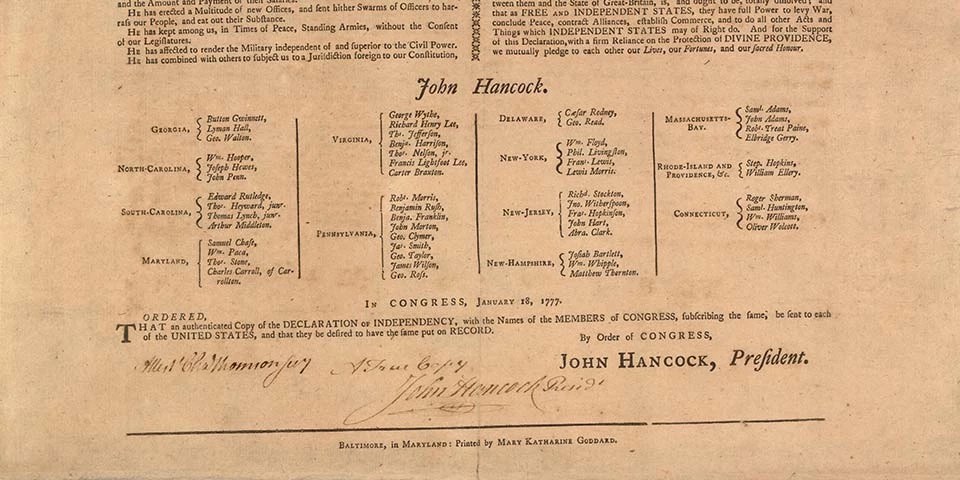
A copy of the Dunlap version.
HOANG: It’s terrific knowing that your scholarly interest in the Declaration of Independence began with a class you taught as a graduate student. It’s another fine example about the relationship between teaching and scholarship, especially at an institution like Pepperdine.
Moving a little closer to your book, will you please describe the following? First, what was the scholarship that inspired and/or challenged you to look into this particular topic? Did it come from literature at all? Or political theory? Or history? Or rhetoric? Or a mix of different disciplines?
DITMORE: Before getting to scholarship proper, I’d begin with the personal interest. Earlier in my life I’d had a loose, unfocused, and sporadic fascination with the U.S.A.’s founding and history that certainly had many gaps and left a lot of stones unturned. So, it felt natural to want put a spotlight on its founding moment from a more mature and capable perspective.
It also helped that one of the things that captivated me in grad school was the idea that America’s values and meanings were to be found in its various founding moments, and especially in early New England. The intellectual historian Perry Miller was crucial to this idea, maybe especially with his article “From Edwards to Emerson”; Miller’s methodology was picked up and elaborated in Sacvan Bercovitch’s The Puritan Origins of the American Self and The American Jeremiad. From these, I was primed to find an originary spot and then work forward from there, expecting to find not only continuities but oftentimes contradictions spawned and networked out of that one spot.
As for Declaration scholarship particularly, I was really starting from scratch, especially since it so far afield from my other work. At the time (in the 1990s), scholarly resources were more limited and uneven in distribution. If anyone (including myself) had bothered to ask what my own “position” on the Declaration was, I couldn’t have said much more than “deep veneration mixed with great ignorance.” Putting that aside, though, just think of the immense amount of serious publications, in the broadest sense possible, on the Declaration. And then, I didn’t really know the American Revolution all that well, especially in intellectual and literary terms. Most of us take all that for granted, if we take it much at all.
Naturally, I needed to narrow, specifically to the kinds of material an English professor would be expected to know – the Declaration as a literary and rhetorical work, its literary and rhetorical backgrounds, its composition and textual histories, etc. Those are matters that wouldn’t have crossed my mind earlier. But then, I had to wonder why was it even included in a literature anthology in the first place?
I think I must have started with photocopied journal articles, specifically Barry Bell on “reading/misreading” the Declaration, a Wilbur Howell article on the Declaration’s connection to eighteenth-century logic, and another by William Raymond Smith on its rhetoric (and later many excellent articles by Stephen Lucas). Those were all helpful starting places.
The first two books I turned to were Carl Becker’s The Declaration of Independence (1922), something of a standard, and especially Garry Wills’s Inventing America (1978). Edmund Morgan’s Inventing the People was also very helpful. And all that also meant finding and diving into primary sources I’d never explored before.
Those were the nuggets I started with, anyway. But I swiftly realized that I couldn’t afford to ignore Thomas Jefferson (and later, John Adams) – and that that would be a gigantic challenge in itself! But that was far, far from all. Rabbit holes abounded! So, yes, in the end I attempted as broad a mix of disciplines as I thought I could manage. Two more reference-type books were especially useful for me: Robert Ginsberg’s A Casebook on the Declaration of Independenceand especially John Vile’s encyclopedic The Declaration of Independence: America’s First Founding Document in U.S. History and Culture. I’d also recommend Barry Alan Shain’s The Declaration of Independence in Historical Context(2014) for an abundance of primary materials.
But really, the crucial book in many ways was Julian P. Boyd’s The Declaration of Independence: The Evolution of the Text as Shown in Facsimiles of Various Drafts by its Author, Thomas Jefferson (1943, 1945) (it has since been refreshed, in color, by Gerard Gawalt).
For starters.
HOANG: I had a chance to browse over the book, and of course read the entire introduction because it’s perhaps the most important section for a non-specialist like myself. I enjoyed reading about the many names and anecdotes in the introduction. However, I found the very next section equally interesting. Titled “Finding ‘the’ Declaration of Independence: Notes on the Text(s),” this section is mainly about the fact that there are no fewer than “five official version(s)” of the Declaration. The (s) appears to be grammatically erroneous but it actually signifies a complication about the Declaration. You open this section with the following statement:
Readers unfamiliar with the textual and publication history of the Declaration of Independence should know that there is a basic division between the official, authorized versions that stem from the July 4, 1776, approval of the final text by the Second Continental Congress and the various draft versions preserved mainly by Thoomas Jefferson (but also including two different copies by John Adams). While I undertook this work with the aim of limiting attention to official versions, like many other readers I soon discovered how difficult it would be to ignore the Jefferson drafts. Therefore, some discussion of each is in order.
The discussion takes place over the next eleven or twelve pages. What are the main points that you want to impress upon readers in this section?
DITMORE: The “official version(s”) sounds stylistically like me, though. I am very prone to pluralism (and ambiguity: “pluralism(s)”) over singularity; it is sometimes impossible to decide between something absolutely definite and plural, undecidable versions. And I’m willing to break grammar to do it. That, I’d say, is the one main point I wanted to impress upon readers: there is no single “authorized” (as in official and most original) Declaration. Not the one on display in the National Archives, not the Dunlap broadside (the first one to be distributed and copied), or that contained in the transcript journals of the Second Continental Congress. It’s not so much that there are, let’s say, nation-altering differences between them but there are significant differences (in title, format, context, etc.).
Really, here I aimed to revise an observation by Julian Boyd that there are three equally “authorized” versions (as listed above), and of them he chose the National Archives engrossed parchment for his copy text in The Papers of Thomas Jefferson, which I thought to be a poor choice as it has, in formatting, the most cluttered appearance (even though it may “feel” like the one “closest” to the originating moment). I added two others for consideration: that printed contemporaneously in Congress’s journals (drawn from the manuscript journals) and finally a second broadside, from early 1777, which had been commissioned by Congress for distribution to the various states’ official records. That one was printed by a woman, Mary Katherine Goddard, in Baltimore; and that is the one I selected for my copy text in the book, because, for the first time in public, it combined the formatting of the Dunlap broadside with the signers’ names — and because it was officially authorized by Congress.
Why is any of that “really” important? Mainly because the method of the book was to be an explication, or close reading, of the Declaration’s text; to explicate anything, however, one must completely trust the text one is explicating. And that kind of textual integrity isn’t as easy to attain as one might think, even for a document that might seem so singular as the Declaration. Likewise, in literary (and rhetorical) interpretation, the critic’s first step is to establish and justify the text under investigation, which is what this section is all about.
That leads to a second point, though, which has to do with the various draft versions (in draft, correspondence, and manuscript forms), most of them made and preserved by Jefferson, and which no serious Declaration reader can afford to ignore. Taken into close consideration, they are not at cross purposes with the final version edited by Congress, but they do suggest the possibility of alternative texts — and they can offer insight, in the absence of much concrete information at all, into how Jefferson conceived and executed the draft (with the drafting committee’s knowledge) and then what values and discernment might have guided Congress in its edits.
This possibility of a “director’s cut” of the Declaration, so to speak, I’d like to blame squarely on Jefferson, since he had so heavy a hand in its preservation. But even had Jefferson destroyed all the draft material, we’d still have two draft versions made by John Adams (one full and one partial), except that they came into public view very slowly (only in the twentieth century, really, beginning in 1943). But Adams himself seems to have forgotten he’d ever done such a thing. At least, he never referred to or commented on them, although he did recall elements of Congress’s editing. Even so, Adams’s full version alone would have set off alarm bells among readers.
HOANG: Thanks! Let’s get into the body of the book. You wrote the following in the Introduction regarding reading the Declaration of Independence:
I propose an alternative approach, a reversal of sorts. Rather than gazing at the Declaration and attempting to read it more clearly and cleanly–and then reporting one’s eyewitness accounts–let us suppose we consider the Declaration as an agent itself, in its wording and formatting operationalizing Americans: creating and directing knowledgeable ideologies and practices as unmistakably Declaration-derived (if also sometimes errantly so).
Chapter 1 is indeed about the Declaration as “agency,” but there’s a particular association in your usage. That is, you associate “liberty” to “agency.” In turn, it’s impossible to analyze “liberty” without the context of “slavery.” Please give a summary of your argument in this chapter, and include an explanation about the association among these terms: agency, liberty, and slavery.
DITMORE: One of the most basic points in the book concerns an obvious and unoriginal observation, dating back to the Revolutionary period, which is that the patriot pamphleteers and writers unhesitatingly described the English administration’s actions – whether from Parliament or George III – in enslavement terms. Taxation with representation, quartering of troops, military desolation of entire towns, anti-naturalization policies, etc., etc. – if such matters indicated tyranny, then they also indicated enslavement, and patriots were swift to use that rhetoric without batting an eyelash. But others (like Samuel Johnson) were equally swift to spot the brutal irony of slaveholders complaining about being enslaved. There is simply no easy way around this. It can be found in numerous ways, as numerous historians have called it out.
Even some colonists – maybe a very, very few – were aware of the issue, as I point out with the Associator Humanus opinion piece in the Purdie & Dixon Virginia Gazette of July 18, 1771. Granted, Associator Humanus’s piece seems to have sunk without a trace of a response, but, in a way, it points toward three kinds of enslavement: that of the British tyrants (against which there had been a non-importation movement), that of the Virginia slaveholders against people of African descent, and, finally and somewhat surprisingly, an addiction to slaveholding cultivated among the Virginia slaveholders by the British in some very devious way.
In short, if “liberty” is a profoundly cherished but vague term for unbridled agency, “slavery” became an easily applicable term to anything that frustrated the colonists’ agentive ventures, collectively or individually. I don’t mean to undercut the seriousness of the charge. The British were absolutely, and stupidly, exploiting the colonists and preventing them from the full extent of trade, among other things. British actions were extraordinarily shortsighted, impractical, and unfair. And if I’m being charitable, I’d even say that the colonists had simply no other rhetoric to resort to but that of enslavement when it came to the oppression they were experiencing. But for those especially in the South, enslavement rhetoric could not be exploited without exposure of their own unbudging and enslaving hypocrisy, and that problem would simply worsen as time went by and observers gained some distance.
If I may give an odd example: In the Stone and Edwards musical 1776, just before the blockbuster number “Molasses to Rum” (about the triangular transatlantic slave trade), for some unaccountable reason they have Thomas Jefferson claim that he had “already resolved to release [his] slaves.” It’s a very noble sentiment, but talk about poetic license! There’s no reason to think that such a thought ever once crossed Jefferson’s mind; it never issued from any of his quills. Certainly, he never acted upon such a sentiment. It’s simply a cheap way to save Jefferson’s reputation, I guess.
To get at this problem, I found myself attending to various slave advertisements in issues of Virginia Gazettes when documents like the Virginia Declaration of Rights, the Virginia Constitution, and the Declaration of Independence first appeared. They are painful to read – not just runaway ads, which are awful enough (in the wake of the Dunmore proclamation), but auctions and then estate leases and sales as well, anonymized along with furniture and cattle and whatever else. If the American revolutionaries could so easily see their own restrictions on economic and political agency as enslavement, how could they so casually perpetuate lifelong and generational enslavement among others?
HOANG: To readers who’ve read your responses above, especially the last one, I can only urge them to get a copy of the book and read it for themselves. All the same, please share the most significant points in the remaining chapters (and Conclusion).
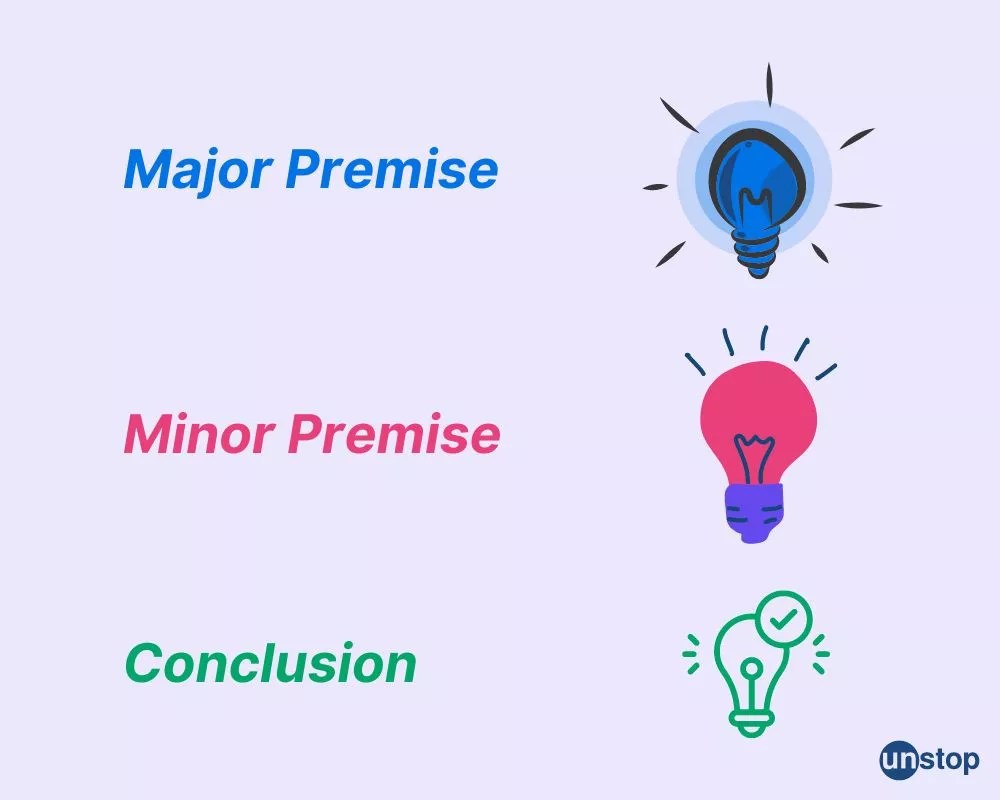
DITMORE: First of all, although the idea is not original with me, I came to see that Jefferson designed the Declaration’s structure to be in the form of a conditional syllogism (with three essential components: a Major Premise, a Minor Premise, and a Conclusion). But that is really a rhetorical, rather than a strictly logical, gesture, one that connotes an appeal to universal reason — and one that leads to a dispassionate, necessary conclusion (of separation).
But I also realized that each of these three major sections are composed in different genres (very much unlike how a tight conditional syllogism ideally would be constructed): axioms of political rights (Major Premise); a bill of indictments (Minor Premise); a speech act (Conclusion). From that angle, the Declaration resembles a quilt seamlessly sewn together from different pieces of cloth. That allowed me to consider each section separately, and then in each case to pinpoint specific details for closer analysis. But agency, broadly but also grammatically considered, became a thread I could trace through all three.
For the Major Premise’s layout of rights, I focused first on grammatical formulations, in terms of passive voice syntactic structures, and then in terms of the overall chain of the formulation leading to the conditional statement (if a government threatens or fails to protect the rights of the people, then the people have the right to alter or abolish said government and institute a different one; the Declaration is much more about the “alter or abolish” element than the instituting of another government). It turned out that in earlier drafts Jefferson had not aligned all these statements in the same passive voice form, but that’s exactly what had happened by the time of the submitted draft, and that realignment, along with some agentless passive voice, masked a shift in agency from Creator to people.
As for the Minor Premise, instead of either sorting through the 17 (or 27) grievances one by one (as has been done several times) or providing a more comprehensive account of them all, I decided instead to focus on the most notorious grievance of all, the slavery clause — conspicuous by absence, because Congress deleted it entirely sometime during the editing on July 3 and 4. I don’t know that I’ve encountered a serious reader of the Declaration who thinks the slavery clause shouldn’t have been deleted.
But two things needed to happen. First, the extent to which the catalog of grievances derived from Jefferson’s drafts of a Virgina constitution needed to be worked out, particularly therefore in terms of the early draft forms of the slavery clause. (The final version was something like five or six times longer.) And second, I wanted to attempt something like a close reading, or explication, of the submitted slavery clause, even to see if it is possible to detect any cogency in at all. (My conclusion: no, there is no cogency to it, and that must have been a big part of why it was deleted.)
That meant, however, exploring one of the central accusations of the slavery clause, viz. that George III had repeatedly vetoed Virginia legislative efforts to place prohibitive import tariffs on the transatlantic slave trade — and that made getting into the weeds of seventeenth- and eighteenth-century Virginia legislative history — and that led me to something that has, I think, been neglected, and which I wound up calling “the Virginia antislavery myth.” Basically, this myth mixed (and still mixes) fact and fiction to claim that Virginia slaveholders had never wanted enslavement in the first place and did all that they could to eradicate it; it was the British alone — as agents — who legally perpetuated enslavement in Virginia.
The Conclusion: To a large degree, this was the more difficult of the chapters for me. It was very tempting just to wrap up with something like: “and so they declared independence, and that was that.” Here, though, I focused on a peculiarity of Jefferson’s rendition of Congress’s editing in his “Notes” manuscript. While he pointed at the two editing matters that most bothered him — the slavery clause and severe pruning of the “British brethren” clause — he entirely ignored the changes made in the conclusion, which were extensive enough that he abandoned the format he used to virtually indicate the other editing and instead used double columns.
Reading those columns carefully shows, one, that Congress inserted “God language” not in the submitted draft, and, two, that Congress directed that the verbatim wording of the June 7 Lee resolution for independence be inserted in place of a paraphrase. After all (in my view), the wording of the Lee resolution is what Congress had approved on July 2.
But then — the conclusion is the section in which, yes, independence is verbally declared, and that led me back to a consideration of speech act theory, first described by J.L. Austin. But this further led me to a Bicentennial talk given by Jacques Derrida at the University of Virginia. While we rightly tend to associate Derrida with deconstruction, he was also very interested in speech act theory, and in the 1970s and 1980s had gotten into a verbal brawl with John Searle (one of Austin’s students and maybe a kind of self-proclaimed authority on speech act theory). Anyway — I thought Derrida’s comments might be insightful or helpful. But they weren’t so, really, except in the sense of spring boarding a more helpful account. Yet he did helpfully touch on the most sensitive element: how does a politically unrecognized representative body verbally self-authorize itself to issue political enactments (like independence)?
Of course, in one way that is the basic assertion of the Declaration: the people always can be so collectively self-authorized at any time they choose to do so. But in doing so, they will not necessarily hew to previously accepted speech act norms; such situations arise only in emergency and in exception, and therefore are thin on precedent.
As for my conclusion … to be candid, I felt as though I’d done enough and was in danger of overstaying my welcome, and I needed to wrap things up. The parenthesis reflects concerns I’d raised in the introduction, about the sensitivity and efficacy of a close examination of the Declaration. Is it really feasible to think that a close examination that might disrupt not only an understanding but a practicing of the Declaration?
I’d recently been reading a book review by John Philip Reid, not now so widely known but in his time one of the most brilliant of intellectual historians of this period. In it, I detected a note of scholarly despair about dislodging deeply entrenched myths about the Declaration (for example, the overemphasis on the Lockean influence, sometimes to the exclusion of other influences), even among scholars who ought to know better. I suppose something in Reid’s tone also brought out the spirit of Henry Adams in me.
Still in closing, I wanted briefly to consider and assess some basic strands of Declaration appreciation and appropriation. Throughout the project, I found myself not infrequently asking something like, “what must have been the essential element of the Declaration draft”? Congress’s editing suggests that even more editing might have been done, although they were under pressure to get the matter before the public.
Finally, it came down to this for me: the June 7 Lee resolution for independence, and that alone. The Declaration essentially need not have gone beyond publishing that (perhaps along with a vote count). But, one might counter, the resolution says nothing about human rights, says nothing about motivation or justification for so extraordinary and difficult a move — in fact, the resolution in no way really reflects the virtue or character of the American people devising this action.
All true, very true. But then, the virtue and character of the American people is always up to the present American people, not its past. Perhaps of instead of staring so intently at the Declaration itself, the American people should share intently at themselves as a people, generated by the Declaration but sustained — to the extent that they are — by their own virtue and character.
 tuannyriver
Leave a comment