It’s difficult to write a sustained and serious biography of Trịnh Công Sơn, even one about only one portion of his life. One would need primary materials: documents, private correspondence, business correspondence, interviews, etc. How many such documents still exist? How can one access those that exist? I still hold out the hope for such a biography, but the prospects aren’t that great twenty-five years after his death.
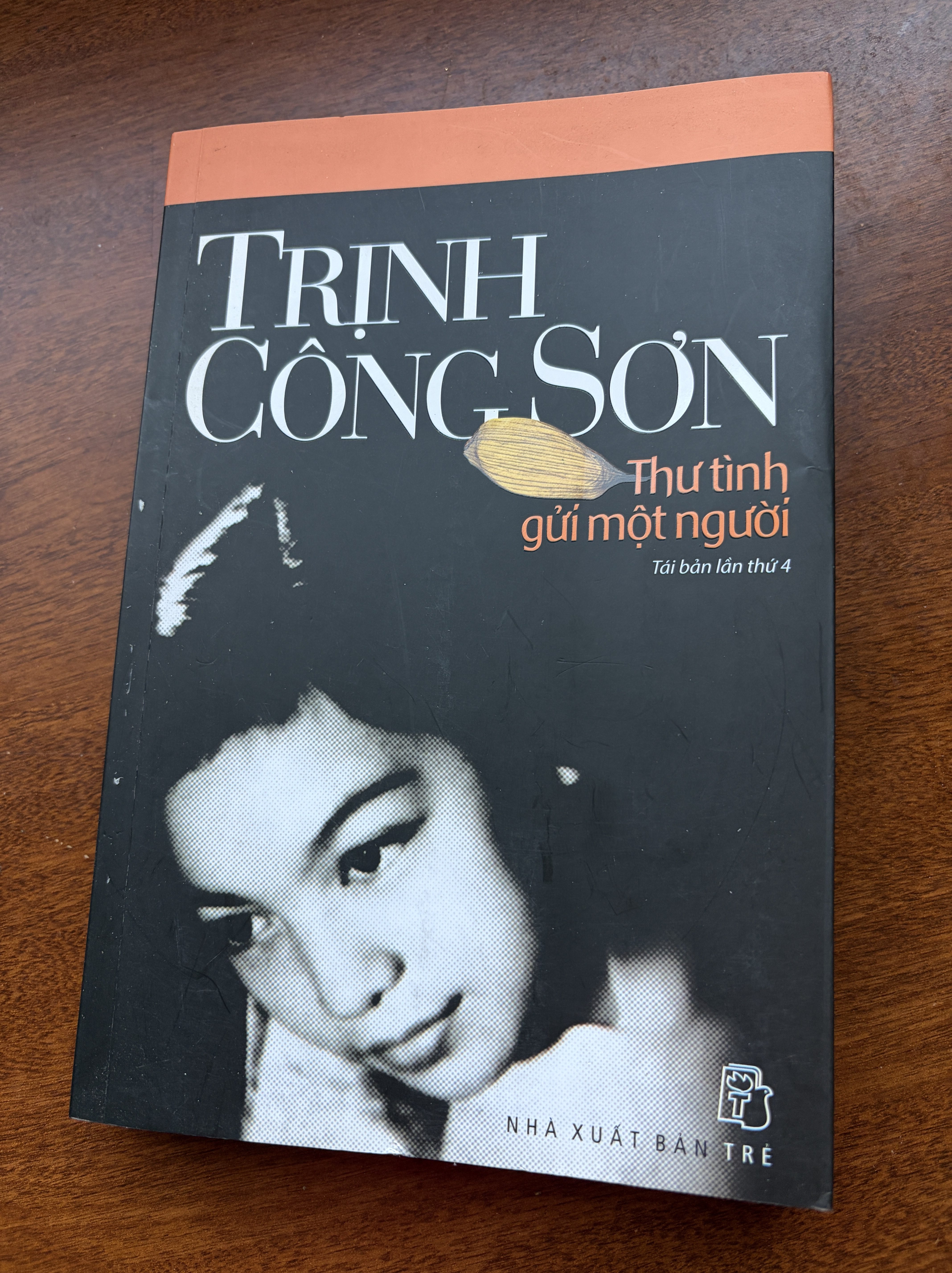
That said, it’s not shabby to start with a collection of his private correspondence, Trịnh Công Sơn: Thư tình gửi một người [Trinh Cong Son: Love Letters for a Young Woman], which was published in 2011 by the Vietnamese press Trẻ. (The subtitle literally means “love letters sent to a person,” which sounds impersonal if not also crude for such private contents.) Two years ago, I bought a physical copy at the Tự Lực Bookstore in Little Saigon, but it sat on my bookshelves until recently when I finally browsed the pages. Many folks have apparently uploaded digital copies on the Internet, including this one. Some Vietnamese have also excerpted certain letters: e.g., here and here and here.
Common to Vietnamese publishing practices, Trẻ appeared to publish only a thousand physical copies of the collection in 2011. Demand led to more printings, and my copy was the fourth printing in 2016, also a thousand copies. Moreover, people have found ways, legally and illegally, to circulate books that interested them. The aforementioned online circulation of Love Letters is a prime example of popular interest on the life of TCS, and I’d say that many more people have read some or all of these letters.
The collection consists of letters that TCS wrote to Ngô Vũ Dao Ánh, then a student at the Đồng Khánh High School in Huế. Most letters were dated between 1964 and 1967. TCS previously had some kind of a relationship with her older sister, Bích Diễm, who inspired him to write “Diễm xưa” [Diem of old, or Diem of the past], one of the most popular love songs in Vietnamese modern music. The relationship between TCS and Bích Diễm was long thought to be romantic, but it was possibly more like a quasi-romantic friendship. It was really Dao Ánh, who became TCS’s muse for several love song, that there was a romantic relationship, even though it didn’t become “official” for the first couple of years of their correspondence.
This collection has been well known since its publication. Yet it is rarely used by academic and independent scholars. To my knowledge, only three people have used it towards scholarly ends.
- First is John Schafer, whose citations appear in a chapter of his book about TCS and Bob Dylan published in 2023. This comparative framework has struck me to be misguided, but that isn’t my point here. Rather, my point is that Schafer’s citations reflect scholarly responsibility–and that his usage of the collection is very good for the portions in that chapter on TCS. The chapter is primarily biographical, and he employs the collection to offer details and conjectures on the relationship between his romantic experience and his composition of love songs.
- Second is a working paper from 2025 entitled “Exploring Linguistic Synaesthesia in a Vietnamese Songwriter’s Love Letters.” Its authors, Thien-Bao Nguyen1 and Shelley Ching-yu Depner, are based at National Cheng Kung University in Taiwan. As indicated by the title, the paper seeks to show that TCS’s letters often manifests synesthesia, which they call “a neurological phenomenon in which when one sensory is activated, it arouses another sense. Notwithstanding their rationale for selecting this collection for analysis, I found it slightly odd that they selected it at all. But, hey, they attempt to raise its value beyond casual curiosity and hagiography and into serious scholarly inquiry.
These works are very different in discipline, methodology, and goal. The differences actually illustrate that the collection possesses a richness that could be employed by very different people for very different things. Remarkable, too, none of those three academics is a specialist on Vietnamese music.
Next, I turned to research in the Vietnamese language but didn’t find anything, academic or seriously amateur, that really engages this collection beyond publicity. The book has been around for fifteen years, and its readership appears to be healthy. It’s been a missed opportunity, if you ask me.
In the end, I prefer to look towards the future. Besides my teaching responsibilities, I have more than enough research projects now and in the foreseeable future. Basically, I can’t do TCS because of time constraint–and I may not do a good job at it either.
But, please, very please, interested folks out there! Please help to elevate TCS studies by reading and re-reading this valuable collection then applying it to your research. And if you haven’t researched on TCS, please consider spending time on this subject. It’s a good one to spend time on.


Leave a Reply