It has happened twice. In winter 2008 I drove from South Bend to the Twin Cities for a few days visiting my family. I learned that Art Spring, the founder and former director of the honors program at my alma mater, had died. His funeral took place on the same day that I learned about it, and it was too late to drive up to St. Cloud. I learned the news from Joe Tadie, who added that Pat Costello, who had retired from decades of teaching English, drove up from Winona for Art’s funeral.
Forward to this fall, when I was back in the Cities for another few days of another family visit. This time, I learned from Jane Rodeheffer that Pat Costello had died the week before. Having flown back to California, I missed the funeral and the memorial on campus the day before. Had I been there, I’d share some of the following with the people in attendance.
Pat was among three St. Mary’s faculty that I got to know the most–Jane Rodeheffer and Art Spring being the others–and provided the most mentorship to me. (Later, Jane was also instrumental in mentoring me as a new faculty at Pepperdine.) Uniquely, however, I never took a class taught by him.
- I took several classes each with Art Spring and Rosemond Spring, all in the LaSallian honors program.
- Several classes with Jane Rodeheffer, all for my philosophy major.
- Also for philosophy: four courses with Fr. Fabian, three with Andrea Birch, and one each with Mark Barber and Vinnie Colapietro.
- Two or three courses each from Sr. Sylvia and Bill Cahoy towards my theology minor.
- Two semesters of directed studies in New Testament Greek with Kathy Weiner. I took it along with a seminarian classmate, later Fr. Dan Vacca in the Diocese of Wichita.
- I took four drama courses: two each with Donald Peake and a Christian Brother who taught for only short time and whose name I don’t remember.
- Two courses in American literature taught by a faculty whose name escapes my memory. He was Irish American like Pat, and his wife was a staff at the bookstore.
- Just for the fun of it, I took the course taught by Br. Louis, who was St. Mary’s president at the time. Plus a course on Chinese history taught by Bill Crozier. Eight or nine years later, the latter course played a small role in my decision to pursue a doctorate in history.
Given Pat Costello’s well-known presence–I occasionally saw him at daily mass at the college’s chapel–it was a surprise that I didn’t sign up for one of his courses. In my senior year, however, I asked him to let me sit in his class on the novel. Not all class meetings but only those about The Brothers Karamazov and The Last Gentleman. I really wanted to read them, partially because Art Spring assigned Moby Dick rather than Brothers K. I was also getting into Walker Percy after reading The Moviegoer in one of Jane Rodeheffer’s classes. I think Pat also assigned David Copperfield and The Chosen, among others. But it was Dostoevsky and Percy that I wanted to sit in his class for.
Pat said yes, and it was the beginning of a friendship for years to come.
I remember it was a small class of maybe six or seven English majors and minors. I remember, too, that Pat did most of the talking, and it was sort of like a lecture course. It was the early 1990s. Looking back, I realized that he’d previously taught this novel course so many times that he could have done it in his sleep. He was full of thoughts and insights that made me think. During the last class on The Brothers Karamazov, for example, he emphasized the unresolved nature of the ending. It was as unresolved as the ending of David Copperfield was very much resolved. We are left with no idea, he said, what Alyosha was going to do. He then gave the example of the ending of the classic movie The Third Man. I remember being very impressed by Pat’s description of the movie’s ending: enough to help me connect two very different stories. It became a pedagogical technique that I’ve used ever since I began teaching college myself.
It was the following semester, my very last semester in college, that I really got to know him. I came to his office at least a couple of times and always had a terrific conversation. Shortly before graduation, I shared with him my honors project, a novella about an Amerasian child of a Vietnamese woman and an American soldier who met during the war. As a seminarian, I was included in several events led by the bishop of the Diocese of Winona, John Vlazny. At a dinner one week before graduation, Bishop Vlazny told me that he had a very nice conversation with Pat at a faculty gathering and that Pat mentioned me. Referencing the novella and movie Goodbye, Mr. Chips, the bishop added that Pat was “like Mr. Chips.” I’m pretty sure that he wasn’t the only person who had that thought.
Following the commencement ceremony, I ran into Pat and had a photo taken. It turned out to be the my only graduation photo with a faculty, as the rest were with friends and family members.
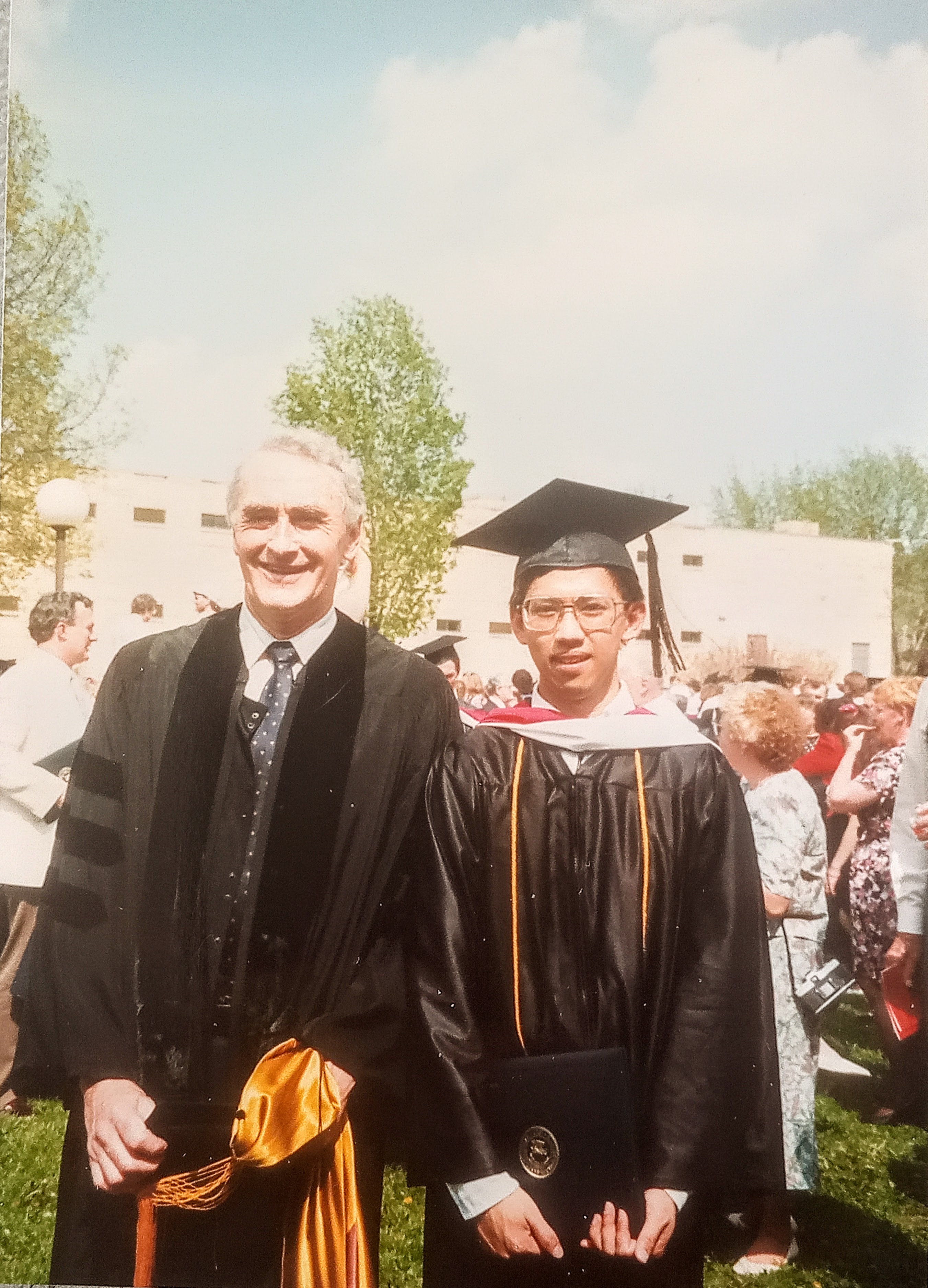
Two weeks later, I moved to the Northwest to be a live-in assistant at the L’Arche community in Seattle. Assistants with multi-year commitment would have a full month off, and I always took my month away during May. I went back to Minnesota for some of that time, and typically drove to campus from Rochester for a few hours. I saw Pat two or three times during those years, and we again had some terrific conversation. One year, I was reading a lot of Saul Bellow’s fiction and spoke with him about it during my visit. He called in his student assistant to make a copy of a journal article he’d published on Bellow’s Seize the Day.
We also corresponded. I’d fill him in about my work and my reading and he’d share his thoughts on this work or that author. I’ve lost those letters, but several things in them are still clear in my mind. In the first letter, Pat passed on the phone number of a close friend of one of his daughters, who was living in Seattle, and said that I might want to connect with her. In a different letter, which he wrote on Thanksgiving Day, he ended by saying, “Have you seen Avalon?” I later did and found it a terrific story about immigrants in America.
I learned about Pat in other ways beyond our interactions. Following the fall of Saigon in 1975, my uncle’s family–husband, wife, five boys from a few months old to eleven years old–became refugees and was resettled in Winona under the sponsorship of the Catholic Cathedral Parish. They lived in Winona for ten years before moving to Pennsylvania. (In between, they helped sponsoring my family to Rochester in the early 1980s.) While Pat attended St. Mary’s Parish rather than the Cathedral, he apparently crossed path with them because of athletics. Four of my cousins attended Catholic schools in Winona and played tennis, basketball, or football at Cotter High School. One of them, my cousin Chien, told me that his basketball team in junior high was coached by “Mr. Costello.” Put it another way, Pat’s student-athlete experience wasn’t the end but the beginning of a lifetime of service, basketball in this case but there was a lot else, throughout his long life.
The last time that I saw Pat in person (and Joan), it was a small gathering at a hotel in downtown Seattle. St. Mary’s office of alumni organized this event. The year, I think, was 1999 and Pat had recently retired. I told him that I was in a transition from L’Arche to graduate school, with temporary work in food service between. Pat was typically his encouraging self, and it left me with another pleasant memory of him.
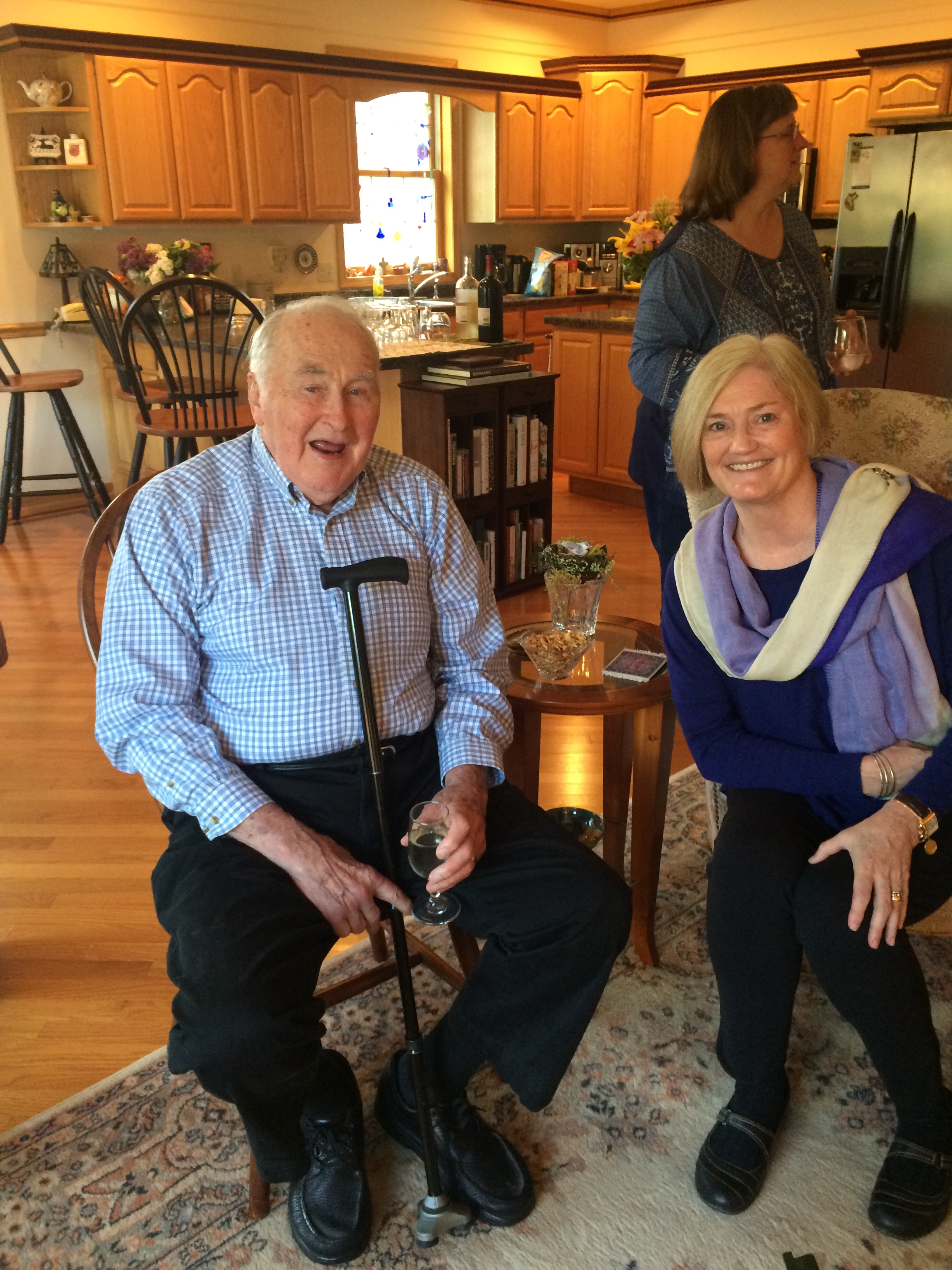
It was one or two years after I began teaching at Pepperdine that we resumed our correspondence, still over letters rather than email. It was another terrific (if shorter) round of conversation: a mix of updates and thoughts on reading and teaching. I learned that Pat never finished reading Paradise Lost; he said it just wasn’t for him. On the other hand, he happily shared that he was able to continue his love for Shakespeare (whose course he taught regularly alongside the novel course) through the Great River Shakespearean Festival. Now that I’ve taught Twelfth Night for over ten years, I’d love to have a conversation with him about it. A few years later, Jane Rodefeffer, who was instrumental in getting me started at Pepperdine, sent me the photo below of her and Pat–Jane wrote he said hi–at a retirement party for their mutual friend and former colleague Mary Fox.
From all I’ve known, Pat Costello was an outstanding example of the “salt of the earth” and “light of the world” that Jesus speaks about in the Gospel of St. Matthew. I’m not the only one seeing that, as many others have shared their appreciation on the Legacy obituary and a FB group to the same effect. To me, he was very much an academic who was simultaneously a lot more than an academic. A life well lived was Pat Costello’s. RIP
 tuannyriver
Leave a comment