Several years ago, Pierre Long Tang, then a Pepperdine faculty, told me with a touch of despair that undergraduates couldn’t listen to Bruckner because his symphonies are too complex and too long for their attention span. I’d imagine they felt somewhat the same about Mahler. We live in an age of minuets and scherzos apt for TikTok, not oratorios and concertos. And certainly not symphonies from late romanticism that rack up an hour’s time on average.
THE PAINTERLY FIRST SYMPHONY
In my mid-twenties, I listened to Mahler’s first two symphonies a whole lot, but none of the others even though I had several CDs. Pierre’s comment about Bruckner has stuck in my head, and I still want to get to Bruckner’s nine in the future. But I’d like to return to Mahler first, and plan to listen to all of his symphonies. An occasion presented itself: I bought a new car and its audio was very nice.
I normally go to campus three times a week. During the second week of September, I listened to Mahler’s First Symphony from top to bottom during each commute to and from campus. Its length matches the duration of the commute. Listening to the whole thing for the first time in a quarter-century, I remembered how I was taken by the minimalist opening when I first listened to it in the 1990s. And how long the first movement is in comparison to those of Beethoven, Schubert, Mendelssohn, even Brahms.
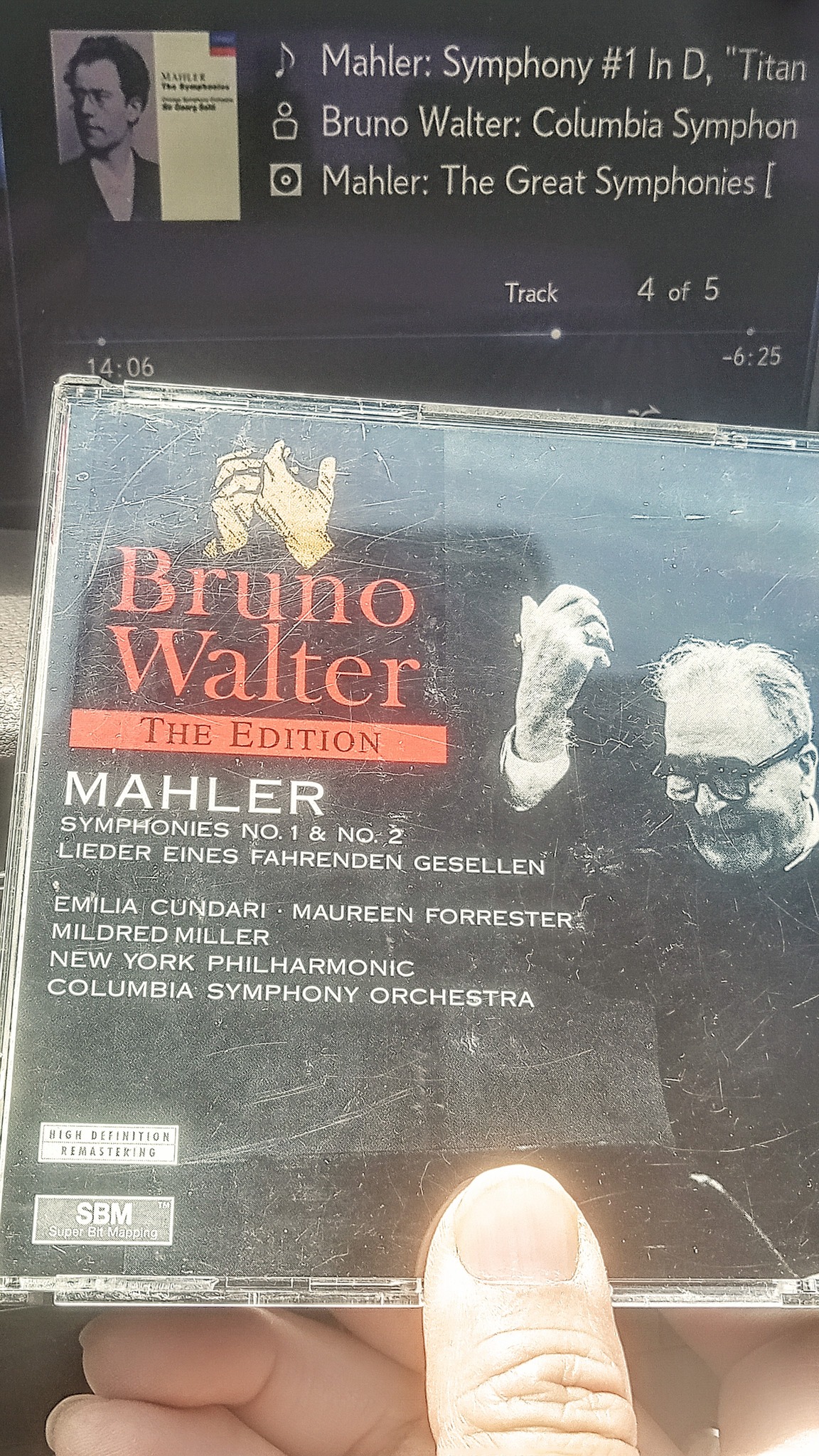
Driving in the dark during the morning commute–I typically left my house at 5:00 AM–I thought listening to the first movement was like watching the sun rising very slowly before quickening into a glorious morning, with birds chirping in the backyard’s trees and people walking their dogs and conversing on the sidewalk of a small street. Mahler had a forest in mind but it’s easy to shift it to a neighborhood like mine: the pastoral into the suburban. A painterly composer was Mahler, and full of contrasts. It’s as if he intended to showcase the full spectrum of volume: from the softest level possible (I had to yank up the volume at certain points) to the loudest. And to give as many contrasts in instrumentation (and as often) as it is possible within a fifteen-minute frame.
The second movement, originally a serenade, could have been a TikTok-like scherzo. Who are we kidding? It’s Mahler, so it has to be twice longer. (It clocks at seven and a half minutes in this recording.) The third movement is my favorite. Back then, I probably re-played it more than any Romantic movement. Stuck in my head are two openings with beats of a marching drum. One is the theme song of “The Good, the Bad, and the Ugly”; the second is this movement. They are, however, very different marches, and it took a genius like Mahler to turn a popular and light-hearted children’s song into a funeral march that is simultaneously solemn, entertaining, and macabre.
At twenty and a half minutes, the fourth movement surpasses all in duration. Was Mahler trying to outdo Beethoven’s fourth movements in the Fifth and Ninth with this fourth movement? I’m not smart enough to know, but goodness gracious, there may be enough volume and variation here to hold off even the short attention span of Gen Z listeners. Reviewing Pelle the Conqueror, the late Stanley Kauffmann wrote something along the line that the film flirts with over-sentimentality several times only to lift itself out just in time. Likewise, this movement flirts with bombast several times only somehow finds a way to lift itself out. I’d guess that Mahler allows the brass section to be dominant but orders it not to completely overwhelm the string section. All right, all right, the last 90 seconds or so are pretty much bombast. But it’s late Romanticism, and what could you expect?
Mahler’s reputation was secure had he not written another symphony. But of course he had to write nine more.
SECOND SYMPHONY: ALL THOSE SIXTEENTH NOTES
Listening to the tension in the opening bars of this five-movement symphony, I thought for a moment about the currently sad state of American politics which is overwhelmed by tension. But it was only a moment before I went back to high art. In Either/Or, Kierkegaard describes music to be the perfect example of immediacy because it is wholly sensuous and wholly pre-reflective. A few seconds after the tremolo of the opening bars, I was swept out of politics and right back to the the flow of sound. Immediacy.

Like the last movement of Symphony 1, the first movement of Symphony 2 is over 20 minutes. While the initial tension was violin- then cello-led, there’s so much brass in this first movement that that, I wager, the trumpeters, trombonists, hornists, and lone tuba player must be very happy when they finish playing the coda. It’s no surprise that Mahler involves little brass in the next movement. He needs them brass players to save their energy because he’s going to need them big time for the last three movements, especially the fifth.
The first movement starts with a funeral march, and how different it is from the funeral march in Symphony 1. Initiated by low strings and woodwinds, this march is much darker than its predecessor. It’s a preview to the heavy drama of Symphony 2. The march forms the first theme of this movement, and it is loud and dominating. It’s so dominating that the second theme seems to be little more than temporary relief. Almost half way through this movement, brass comes to the front. But it’s only the start. For Mahler brings back the first theme (plus all that brass) not once but twice. Both times, I’d naively thought the movement was over only to be thrown back to the tension and violence of this first theme. No wonder the composer prescribes a long pause between the first and second movements, up to five minutes, so that listeners could tell that the first movement is truly over, ha!
The second movement, andante moderato, is among my favorites in all Romantic symphonies. Its opening theme makes me think of Brahms. Three times I listened to this movement around 5:30am, still in complete darkness on the way to campus. The same I felt when driving home in the evening. For it sounded quite filmic.
In particular are two portions. The first portion follows the development of the main theme: a series of sixteenth notes by violins that accompany flutes and oboes only to rise above them. In my 20s, a friend who played violin in an amateur regional orchestra took me to an event with that orchestra. I still remember that her fellow violists talked about playing the Mahlerian sixteenth notes. Now listening to those notes, I imagined myself as a private eye in a movie about Los Angeles in the 1930s or 1940s, following a car from a distance during an investigation. It gets better with a more ominous accentuation before returning to the main theme. This return, which is the second portion, made me envision myself flying on a hot air balloon above Los Angeles and watching the flows of the living below.
Filmic, too, is the third movement. Its main theme is waltz-like and utterly lyrical, yet the timpani’s loudness that opens this movement seems to caution us, if vaguely, that not all is well beneath the melody. Indeed. Both the main theme and its secondary theme would gradually move faster and spin quicker. They would sound more dizzying then frantic then grotesque. I didn’t feel the alleged “cry of despair” in the latter portions of this movement, but, yes, I heard the growing violence amidst the triple-time lyricism.
So taken by the third movement that it took me a while to notice that the fourth movement and its beautiful sung prayer involves a lot of brass. Mahler assigns solo lines to a violin and an oboe, and both the string and woodwind sections are intimately involved throughout. But brass sound is prominent (and gorgeous) in the first minutes of this movement, the shortest of the Resurrection.
Then, boom, the symphony-within-a-symphony that is the last movement!
Listening to it after all these years reminded me why I bought CDs of several Mahler symphonies yet I’d never listened past the first two. It’s because the fifth and final movement of the Resurrection Symphony is long and complex. In writing the earlier movements, Mahler seems to have pushed the sonata form as far as possible. Now, he seems to have attempted to create something new out of the sonata form. It makes for a challenging listening for someone who doesn’t read or play music like myself.
In this regard, the CD of this Leonard Bernstein recording is very helpful because it breaks down this movement into 11 sectors. While driving, I often checked the current sector number on the screen to help myself remember and situate a segment in the movement.
The outburst that opens this movement is deceptive because the first few minutes aren’t really loud and violent. They are mostly made up of a series of melodic solo lines–clarinet, oboe, flute, trombone, trumpet, even the harp–supported by other instruments. I had to watch a couple of videos on YouTube to be sure of the solo instruments, and I saw two harps. Are there other symphonies, by Mahler or someone else, that require two harps?
After some turbulence, the pace slows down again and we are treated to some of the most gorgeous brass sound I’ve ever heard. Mostly trombones at first (playing to the background plucked violin sound) then all other brass instruments, the color and timbre of this sound is breathtaking. When it is joined by strings and woodwind, it becomes majestic but not bombastic–and indicative of this movement’s resurrection. Or, perhaps, one of several resurrections.
Next, the drum roll starts a march that is supposed to be inspired by the Dies irae from the Mass of the Dead, but it decidedly did not sound like a funeral march. Brass is of course central to this march, but so are strings (which takes over the theme and give brass players a quick reprieve) and even woodwinds. Then the “great silence” segment, which is striking for a piccolo solo. I googled around and found this two-minute explanation that references Mahler’s Jewish background.
It’s not possible to convey resurrection without the human voice, and the choral murmurs are like the first signs of daylight slowly breaking through darkness and into dawn. The choir gets louder and louder as it goes on. Instrumentation, including plenty of bells near the end, gets lusher and lusher. Yet it’s always under control, and it doesn’t turn into weepy sentimentality. A remarkable achievement, making this movement a masterpiece-within-a-masterpiece.
SIX MOVEMENTS OF THE THIRD SYMPHONY: WHO DOES THAT?
I only have half of Mahler’s symphonies on CD–no 3-5 and 9-10–and no Spotify or Sirius subscription for listening in my car. Luckily, Pepperdine Libraries has this set buried somewhere in the West LA Campus, and the staff promptly found it for me. Who on earth listen to CDs today? Apparently not only me. I saw at pick-up that a music faculty, whose last name shares the same first letter as mine, had requested several CDs.

First movement: All about that brass. The last movement of Symphony 2 is over 30 minutes long. So is the first movement of Symphony 3: another symphony-within-a-symphony. My morning commute is approximately 30 minutes between home and the main exit to LAX, and I’ve now associated this half-commute to these two movements. They are different. Both are full of intricacies, but the first movement of the Third is a lot easier to follow. By my third listening, I felt as if Mahler had set out upon writing and said to himself, “I have this idea for a march; let’s see how many variations and developments I can come up with.”
There are as a result several marches, but they are preceded by a hot-and-heavy slowness in the first five minutes before the march theme is introduced. I thought it kind of funny that the theme is first played by an oboe then violin. Why? Because it’s for marches, which are brass-dominant. The US Marines Band has indeed performed this movement without a string section.
This theme appears at least three times before shifting into a march around the tenth minute mark. It’s march after march thereafter, albeit with breaks of slow solos so the brass players could catch a breather. It could have been a theme in an old Disney movie, I thought. The next day, I googled about this movement and found confirmation in the little joke that this theme could be, “Be our guest, be our guest…” LOL
Later, I followed up my commute by watching a few YouTube videos of this symphony. In one performance, the audience actually broke into applause at the end of the first movement, as if it was the end of the symphony. The Columbian-Austrian conductor, Andrés Orozco-Estrada, also responded like it was the end of the symphony by applauding the orchestra then walking off the podium. I don’t remember ever seeing such conduct after one movement of any symphony. But this particular performance was nearly 35 minutes, and it’s understandable that the audience wanted to acknowledge the work rather than customarily waiting until the very end.
Movements 2 and 3. In an episode of “Fresh Off the Boat,” the TV comedy series about an Asian American family, the mother (played by Constance Wu) finds her oldest son’s girlfriend to be perfect but very boring. She then learns that she isn’t his girlfriend at all. “Who’s your girlfriend,” asked she. He points at the piccolo player in the youth orchestra, and she exclaims, “First-chair piccolo!” The impression turns into love when she learns that the youngster had targeted this instrument because “there are a lot of unclaimed piccolo scholarships.” It’s music to the immigrant mom’s ears, always in the lookout for discounts and other cost-cutting strategies in order to advance the social mobility of her kids.
I thought of that episode because after the lengthy, brassy first movement, it was both relief and joy to hear strings and woodwinds taking over for the next couple of movements. And there are many solos that keep busy the concertmaster and, especially, the principals (first chairs) of oboe, flute, and clarinet. Started by the first-chair oboe, the melody is tenderly and classically Romantic. It’s Mahler so the second movement is necessarily long at about ten minutes. But it is carried so well by the melodious theme and solo variations that it didn’t feel that long at all.
There are even more solos in the third movement as it’s over 16 minutes. It starts with plucked violins but quickly draws back the woodwinds, including the principal clarinetist and, yay, principal piccoloist. The concertmaster, principal hornist, and, especially, principal trumpet player have their moments in this movement. I don’t remember ever asking my then-roommate Ryan Berndt whether he’d played solos in a Mahler work. Well, driving in the dark, both to and from campus, I visualized him doing just that while listening to the posthorn solo. Notwithstanding this trumpet solo (and the horn solo beforehand), the third movement is essentially woodwinds, including a rare solo written for the principal bassoonist. Painterly Mahler is, and he utilizes many different sounds to convey the natural world in this movement.
Movements 4-6. This past summer, the Pacific Coast Highway was reopened along with 23 red lights from the Santa Monica Pier to campus. After a semester of taking a longer route (70 miles each way), it was a relief to return to the PCH. There are a few miles slowing down due to construction, but listening to the faster movements during that stretch has made the drive feel quicker. It’s true even when I listened to the fourth movement of Symphony 3, which is quite slow in pace.
Then the fifth movement and the famous addition of a children’s choir (alongside a women’s choir). Ding-dong. Ding-dong. It’s faster than the fourth movement, and it sounds a touch like Christmas. But it’s still relatively slow. I must have listened to these two movements three times over the slow stretch of the PCH. It was apt that the vehicle was being slowed down as I listened to them.
Then the sixth and last movement.
Was Mahler making up for having so much brass in Symphonies 1 and 2? So much that he wrote Symphony 3, and especially its last movement, to be string-dominant? This movement is unforgettable, down to the fact that it lingers on in the last 90 seconds or so, as if Mahler doesn’t want to part.
I couldn’t believe that it took me this long in my life to listen to this adagio.
FOURTH SYMPHONY: THE CLOSEST TO CHAMBER MUSIC
Most of my listening to Mahler takes place during my work commute, but occasionally I’ve also turned on Mahler when driving elsewhere. A few days ago, I drove to Orange Old Towne and met up with a former student now attending Chapman Law School for lunch. I turned on the second movement of the four-movement Symphony 4 during this drive. I found myself asking to the age-old question, “Is Mahler among the greatest composers?”

I’d venture that he’s definitely a great composer, but he’s not among the greatest. Not in the likes of the three big Bs or Schubert or Mozart or even Haydn. The biggest reason is that he hardly wrote any chamber music. Is he among the greatest composers of symphonies? Yes. To be counted among the greatest overall, he’d have written some great trios, quartets, quintets, etc. Which he decidedly didn’t.
This old question came to me because of the second and fourth movements.
First, however, is the opening movement, which sounds pretty charming to my ears. Its first three minutes could easily be the music showing credits at the start of a light comic British or Hollywood movie. The lightness is signaled by the jingle bells that open this movement. The bells reappear at least twice in this movement, and they reappear again in the closing movement. After three massive symphonies, it seems as if Mahler wanted to take a break and, with this one, to return to a more intimate setting (as if “intimate” is possible with him). A smaller orchestra. No choir. And no low brass, as Pierre Long Tang had helpfully informed me.
It was indeed Pierre that gave me a heads-up on the more chamber-like nature of this symphony. I admit to have completely forgotten his point when I first listened to #4, but it took no more than the first minute of the second movement to remind me of this point. Yes, there are quite a few moments in the second movement that make me feel as if I’m listening to a string quartet.
Then the fourth movement, the uncharacteristically shortest movement (albeit not uncharacteristic for Mahler). During my first listening to this movement, I envisioned being in a recital hall and listening to the soprano singing a lied, albeit with piano accompaniment rather than woodwinds. Her singing alternates with more rousing orchestral sections (started by the aforementioned bells). Yet it’s a restrained movement, reflecting the fact that the entire symphony is restrained in comparison to the first three symphonies.
BRASS & STRINGS IN THE FIFTH SYMPHONY
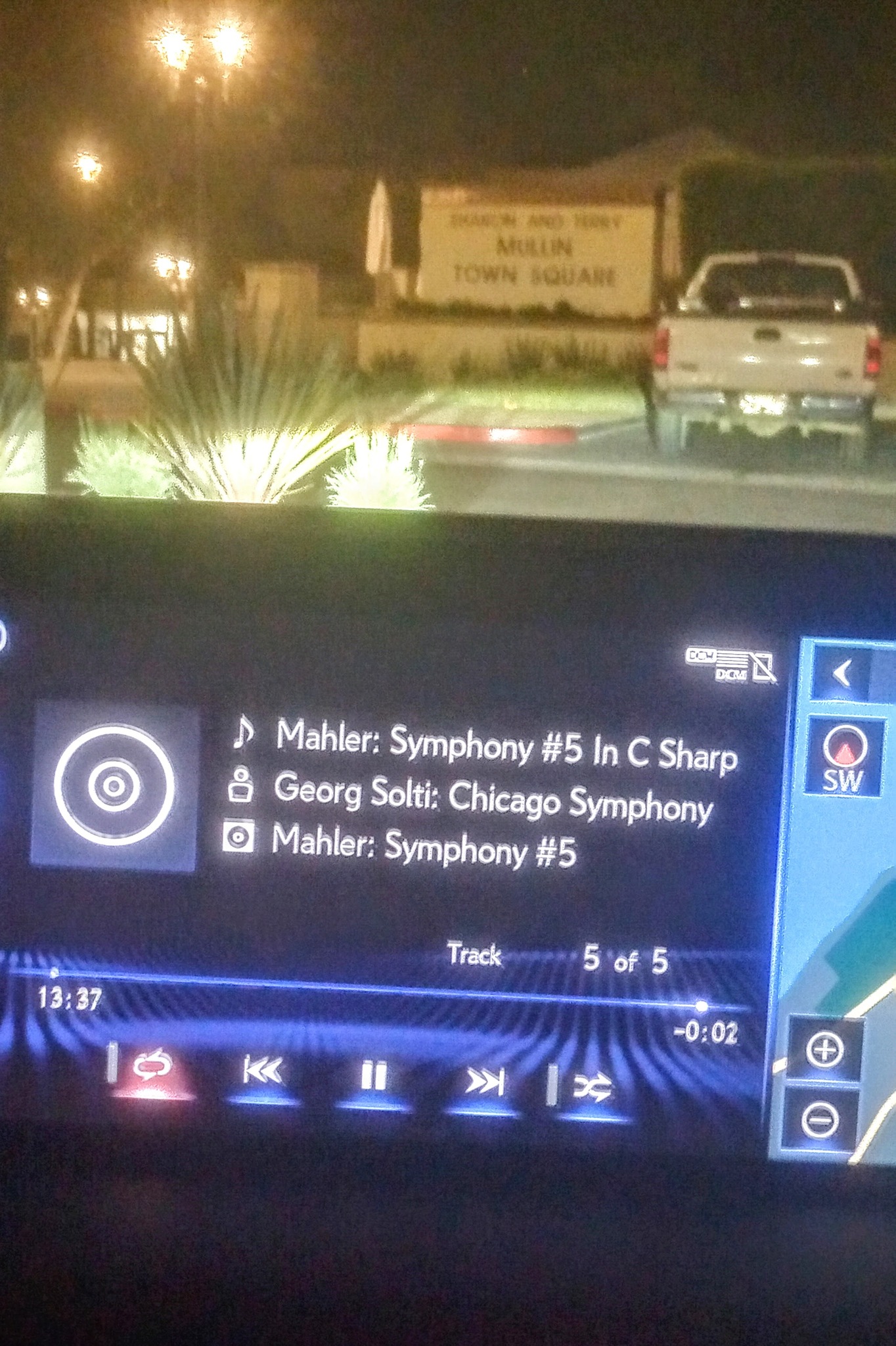
There are 55 miles between my house and where I usually park on campus. It normally takes 60 minutes if I leave by 5am, but post-wildfire construction on the PCH means that it takes a bit longer these days. This CD is 66 minutes long: the exact amount of my commute earlier this week. During one such commute, I imagined the following conversation between Mahler and a friend of his.
FRIEND: Gus, you went string-heavy in the Fourth after three brass-dominant symphonies. Nice change. Is the next one brass or strings?
MAHLER: Hmm…
The trumpet-filled opening of the first movement answers this question. Mahler apparently liked marches, and this march is definitely brassy. Yet there seems to be an equal measure of strings and another equal measure of woodwinds. The strings and woodwinds are usually muter than the brass (which occasionally gets quiet too). But there are also two or three portions when strings are fast and loud. I may be completely wrong here, but my impression after listening to it thrice was that this movement might be the most evenly integrated among the four instrumental sections, including percussion.
The second movement confirms this impression. In addition, the first movement shows many contrasts, and yet there seems to be even more contrasts in the second movement. I really, really liked both movements, which make up Part 1 of this symphony.
Mahler liked marches, and Mahler liked dances. The third movement (which makes up Part 2) is another elaborate and lengthy series of dance, including two or three waltzes.
Then comes Part 3, consisting of the last two movements. The fourth movement is apparently the most performed of all Mahler’s works. I admit to being still very taken by the last movement of Symphony 3 that I haven’t given this Adagietto the attention it deserves. Or, for that matter, the next movement. But I’m still early to Mahler’s Fifth and I’m giving myself time to absorb it.


July 2, 2026 at 11:53 am
Mahler is great, and Bruckner is even better! Enjoy in good health!