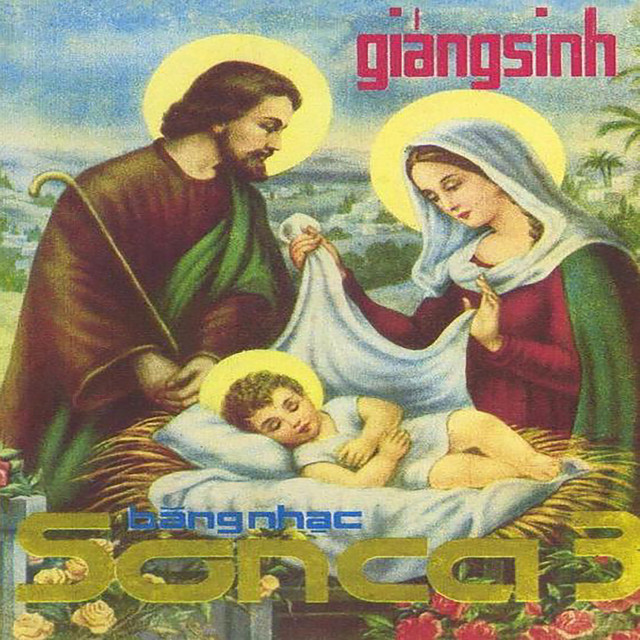
True, the pickings are slim because there haven’t been many Christmas albums in modern Vietnamese history. But Sơn Ca 3 isn’t only the greatest Christmas album. It also ranks among the greatest albums of Vietnamese popular music. Personally, I’d rate it among the top twenty albums produced and released in the Republic of Vietnam (1955-1975). Even, possibly, a top-ten selection.
There are a number of reasons for my judgment, including the following two reasons. First is thematic coherence. As indicated by an inside cover, the twin subjects of national peace and romantic love are coherently presented and juxtaposed to the context of Christmas. Peace was a national matter; romantic love, a personal one.
The weaving between the national and the personal was common enough in many albums released in the 1960s and 1970s. In this case, however, they were tied to the growing popularity of celebrating Christmas among Vietnamese. Especially among urban people, including non-Christian Vietnamese who transcended its religious aspects by joining in the festive atmosphere on the streets on Christmas Eve. The hopes and prayers for peace among the lyrics of many songs were echoes of the intense desire for peace since the 1950s. Lyrics about the experiences of romantic, some happy and some unhappy, reflect evolving sensibilities regarding first love and marriage. (See the first four paragraphs in this post of mine.) Well woven are the national and the personal, revealing two very different concerns that were nonetheless very significant to Vietnamese during this era.
In addition, the album showcases very well-matched assignments of singers to songs. The singers were a strong mix of established and rising stars in the urban musical scene. Which in turn reflect a variety of rhythms and contents. There are nine songs on each side of its cassette tape. Some are slow in pace, some faster, some slower. While most singers were specialists on tình ca [romantic music], four tunes are bolero. Three are Western songs, including two hymns and one popular winter tune. A third hymn is Vietnamese.
Some background on the cassette tape’s impact on recordings in South Vietnam. Introduced by the Dutch company Philips in 1963, the cassette tape was gaining enormous traction in Saigon by the early 1970s. In Western countries at the time, cassette tapes of pre-recorded albums actually cost more to produce, as the length of a cassette tape had to match, more or less, the length of the album. LP records continued to dominate the marketplace, and it wasn’t until the early 1980s that cassette tapes outsold LPs in the U.S.
In South Vietnam, however, producers would purchase blank cassette tapes of 45 minutes on each side then fill each side with music and other contents (e.g., a spoken introduction or farewell). This method meant a less pricey product for buyers, but it also presented a new challenge of getting enough contents for both sides. Length had always dictated contents, but the shift to cassette tapes meant that a cassette-based album would be a good deal longer than LP records. Producers needed to find enough contents to keep listeners entertained for an hour and a half.
In the early 1970s, the musician Nguyễn Văn Đông (pen name Phượng Linh) began the album series Sơn Ca (whose name means the Oriental skylark). Đông was a long-time officer in the South Vietnamese military. In 1960, he co-founded the music company Continental and became its director. By the end of that decade, Continental became an early advocate for producing albums in cassette tapes. The Sơn Ca series was a consequence of this new strategy of production.
In some respects, the series perfectly illustrated the overlaps between the technological shift and a modified organization to accommodate longer contents. It released ten albums between 1971 and 1975, several of which, especially the album of Khánh Ly singing romantic songs of Trịnh Công Sơn, became classics. The releases were steady, suggesting stability of the company as well as the popularity of the series. In fact, the last album in the series was released in April 1975, the last month of the Republic’s existence as well as the existence of Continental. Note: There was an assigned number to the title of each album, but for unclear reasons there was no number 4. As a result, the last album was named Sơn Ca 11.
The initial album in the series was released in 1971. The following year saw the releases of two albums: one near the beginning of the year to celebrate the Year of the Rat (Nhâm Tý); one near the end to celebrate Christmas. All three albums were collections of many singers.
After a spoken introduction, Side A of the album includes the following recordings.
Title & author(s) | Singer(s) | Notes |
| Đêm thánh vô cùng [Silent Night, Holy Night] Gruber | Hoàng Oanh | Silent Night with Vietnamese lyrics by Nguyễn Văn Đông himself. |
| Bài thánh ca buồn [The sorrowful hymn] Nguyễn Vũ Few of his songs were recorded and released, and this song is by far his best-known. The title is somewhat misleading. The hymn of the title isn’t sorrowful. Rather, sorrow is the narrator’s emotion upon listening to a Christmas hymn. | Thái Châu Only twenty-one years old at the time of the album’s release, he was a rising star in the Saigon music scene. Were it not been for the fall of Saigon, he might end up being a superstar in South Vietnam, rivaling the older Elvis Phương. This tune became his signature song. | Singing to a slow rock rhythm, the narrator recollects a Christmas spent with a former love, only to see her getting married to someone else later on. (It isn’t stated out right, but she was likely pressured by her parents to marry another man.) Ever since, he thinks of her whenever Christmas comes round. This song became enormously popular among Vietnamese: likely the best-known and most-sung Christmas love song in Vietnamese history. |
| Xin Chúa thấu lòng con [Lord, hear my inner thoughts] Nguyễn Văn Đông | Thanh Lan | Although the introduction explicitly speaks about the desire for peace amidst warfare, the subject of war and peace properly enters the album with this song. The singer affirms her religious faith since childhood, references her beloved who is a soldier, and prays to God “on high” for peace and the safe return of her beloved. The lyrics also mentions “warfare decades long” as a direct reference to the armed conflicts since the 1940s. |
| Cao cung lên [Raise high the octave] Hoài Đức & Nguyễn Khúc Xuyên Both authors were Catholic priests in the Republic of Vietnam, although the latter left the priesthood in the late 1960s. They composed this hymn in 1945, when they were seminarians in Hanoi. | Thái Thanh, Sĩ Phú, Anh Khoa The first singer was perhaps the first “superstar” of Western-based popular music in South Vietnam. The second was younger and less present due to his status as a military officer. But he was well known enough. The last was the youngest, and the only among this trio to have been born in southern Vietnam. He was also a rising star, albeit better known than Thái Châu since he had recorded more at this point. | There are two Western hymns in this album: Silent Night and Ave Maria. This one, on the other hand, is an original Vietnamese hymn composed by two Catholic priests. Usually performed by a choir at mass, it’s also suitable for a solo performer. For this reason, I’ve thought of it as the Vietnamese equivalent of O Holy Night. |
| Hồi chuông nửa đêm (The midnight bells) Vietnamese lyrics by Phượng Linh | Connie Kim She was an excellent choice for this recording, thanks to her specialty on happy songs with a fast beat. | A rendition of Jingle Bells, the Vietnamese lyrics don’t really correspond to the original lyrics in English. The original lyrics are about the fun of sleigh riding. The Vietnamese lyrics, however, are about the ringing of church bells. Its inclusion might reflect the cultural influence of American pop culture, especially as a result of the US military presence, which led to radio and TV broadcasts catered to American soldiers. We could interpret this recording as a small example of the Vietnamization of Western popular culture. |
| Mừng Chúa ra đời (Welcoming the birth of the Lord) Tô Thanh Tùng | Sĩ Phú His deep-toned voice proves to be perfect for this reflective song. | This song focuses on warfare and peace. It begins with the star of Bethlehem and the Virgin Mary in the first verse then moves to the narrator himself. The chorus is about his life as a soldier welcoming Christmas. The final verse is a prayer that God will bless and protect the Vietnamese nation, and give it a bright future. |
| Ave Maria Schubert; Vietnamese lyrics by Nguyễn Văn Đông | Thái Thanh She might have been the only popular singer at the time to pull off the high notes of this classic. | |
| Tình người ngoại đạo (Love of a non-Christian) Thủy Linh | Anh Khoa | Another classic Christmas love song. This narrator, however, is a non-Christian quietly falling in love with a Christian (presumably Catholic), which, depending on the situation, might pose a problem. The lyrics are his prayer that he would believe in God in the hope of marrying her. |
| Đêm thánh huy hoàng (Bright, holy night] Nguyễn Văn Đông | Khánh Ly | Played almost like a light dance, this song focuses on the classic association of the birth of Jesus to peace on earth. Its desire for “no more warfare” is expressed universally rather than locally, as there are no references to “my country” or “our country.” |
In other words, Side A navigates among four Christian tunes (two Western hymns; one Vietnamese hymn, and one Western winter tune turned into lyrics with religious meaning); two songs squarely on war and peace; two songs squarely on romantic love; and one song about national peace and romantic love.
Unlike Side A, Side B includes no Western tunes and all Vietnamese. As a result, there are more references about war and peace.
| Mùa sao sáng [Season of bright stars] Nguyễn Văn Đông | Giao Linh Normally a singer of bolero music, she gave such a strong performance of this non-bolero tune that it is hard to think of another person at the time that could pull it off as well as she did here. The clarity of her voice might have reached its peak with this recording. | The following spoken works precedes the singing: Lord, I am not a Christian, but I believe that you reign on high. The lyrics move between the narrator’s feeling for her beloved and prayer for a peaceful resolution to warfare. The final lines: Virgin Mother, help Vietnamese love one another. The country will believe in God on high. |
| Nửa đêm khấn hứa [Making a vow at midnight] Tuấn Hải | Hà Thanh Like perhaps most singers in the album, she wasn’t a Catholic. In fact, she was a devout Buddhist. Although she never reached the highest tier or a superstar status, her singing career was very productive and solid between 1965 and 1975. | There are four bolero tunes in this album, and this one has turned to be the most popular after the Vietnam War. Since the late 1990s or early 2000s–and alongside the massive revival of bolero music–it’s been recorded by many singers in the diaspora and Vietnam. |
| Hai mùa Noel [Two seasons of Christmas] Đài Phương Trang Several songs were apparently composed for this album, and this is one of them. At the time, Trang was working for Nguyễn Văn Đông at the Continental company, and Đông asked him to write one. | Anh Khoa | The title is somewhat misleading, as there are really three Christmases in the lyrics. He was something of a specialist on sad love songs, and this song is another example of his sub-genre. The narrator met his beloved during the first Christmas. By the second Christmas, they had to part but made a vow to be married in the future. In the present Christmas, however, they were no longer together. |
| Mầu xanh Noel [The green of Christmas] Hoài Phương | Lệ Thu | I think of this recording as bolero-lite, as it is bolero in design but the arranger seems to have moved the beats from a straight-out bolero rhythm. In addition, the singer wasn’t a bolero specialist. In any event, recent recordings have unmistakably followed the bolero rhythm. |
| Mùa hoa tuyết [Season of snow flowers] Xuân Điềm | Uyên Phương I’m somewhat confused by the name. Wasn’t she Lê Uyên, one half of the duo Lê Uyên Phương? If not, who was Uyên Phương? | |
Đêm kỷ niệm [Night of memory] Nguyễn Vũ | Thanh Tuyền and Thanh Vũ It pitches the popular bolero girl singer Thanh Tuyền and the veteran Thanh Vũ. The latter was lesser known but a reliable whenever he was needed for a duet. Like this one. | The only duet of this album, this song’s lyrics are another mediation between the national and the personal. |
| Lời con xin Chúa [My prayer to God] Lê Kim Khánh | Thanh Lan | This song shares some similarities with Thanh Lan’s song on Side A. Both carry serious lyrics yet the pace and arrangement move continuously and smoothly to keep any seriousness fall into heaviness. The national is more prominent in this one, but the personal occasionally pops in and makes its presence known. |
| Bóng nhỏ giáo đường [Shadow of the small church] Phượng Linh A pen name of Nguyễn Văn Đông, Phượng Linh also appears on the inside covers as the album’s arranger. | Giao Linh | Another performance by Giao Linh, this time in proper bolero style that she was known for. The lyrics are perhaps the most explicit in the album regarding the effects of warfare on both the nation and the narrator’s happiness. |
| Dư âm mùa giáng sinh [Echoes of the Christmas season] Ngân Giang | Khánh Ly | Side A had ended with a song of high hope. So does Side B now. The fact that both were recorded by Khánh Ly, gives a certain symmetry to the album itself. |
The spoken closing wishes listeners a season of peace ahead. It’s followed by an excerpt of Giao Linh’s first song on Side B, ending with church bells ringing. A very well-designed conclusion to the album.
It isn’t a perfectly designed album, and one of my complaints is that the producer didn’t move one of Giao Linh’s songs to Side A–and one of Thái Thanh’s songs to Side B. But this is a minor complaint that doesn’t take away the merits of this very well-performed and well-produced album.
For it wasn’t easy at all to get enough contents for a ninety-minute album of a special subject like Christmas and the Vietnamese experience. But Nguyễn Văn Đông pulled it off with this album. There isn’t a single bad recording among the eighteen performances. The hymns and Jingle Bells aside, the album features mostly new songs, most of which have become classics. In retrospect, Sơn Ca 3 was a small but distinct landmark on the all-too-short chronology of recorded music in Vietnamese history.
 tuannyriver
Leave a comment