In New York City for a conference on Vietnam studies, I took the training northward after the conference and spent a working day at the Maryknoll Mission Archives (MMA). My purpose was to take a preliminary look at some documents about Asian American Catholics, mostly during the twenty-year period that followed the Second World War and preceded the Immigration and Nationality Act of 1965.
The main reason for this visit was my basic curiosity about the history of Asian American Catholics, especially in the nineteenth century and the early and mid-twentieth century. To put it bluntly, we don’t know a lot about them and their experiences during those periods. Another reason was my curiosity about primary sources available to researchers on this subject. During my research on Vietnamese Catholic refugees at the Catholic University of America, I came across a few documents about other Asian groups. But I think they were all about the post-1965 era. When I initially contacted the MMA in late 2024, the archivist informed me that there were some available sources in Ossining–and my curiosity was doubly piqued up.
Moreover, I recognized that it’d be quite challenging to study the history of Asian American Catholics. The challege is noted, if indirectly, in Robert Carbonneau’s chapter on Asian American Catholics for The Cambridge Companion to American Catholicism. Edited by Margaret McGuinness and Thomas Rzeznik and published in 2021, this companion does exactly what a companion or handbook should do. It provides a compendium of the historical knowledge on a host of major topics about the history of American Catholicism, including the topic of cultural Catholics. It was the right call by the editors to include one chapter (among nineteen) about Asian American Catholics.
Fr. Carbonneau’s chapter is lucidly written and should be read by anyone interested in teaching or learning about the history of Asian American Catholics. Nonetheless, it reflects the paucity of secondary sources, especially, again, on the pre-1965 eras. The chapter is seventeen pages long but there are only four pages about Asian Catholics before 1965. Longer and more detailed are the sections on the post-1965 era, primarily on Filipinos, Koreans, and Vietnamese.
One reason for this paucity is that the scholarship, even on the post-1965 eras, has come primarily from the social science rather than the discipline of history. Filipino American Catholics provide a prime example. There have been a number of works, including books, on this topic from social scientists, who duly note certain historical aspects about this group of immigrants. But there is little work from historians. The following work may be the only publication from this century that is historical in purpose and archivally grounded in methodology:
- Kathleen Garces-Foley, “From the Melting Pot to the Multicultural Table: Filipino Catholics in Los Angeles,” American Catholic Studies, vol. 120, no. 1 (Spring 2009): 27-53.
This article is based on documents from the Archival Center of the Archdiocese of Los Angeles, the archdiocesan newspaper The Tidings, the historical records of St. Columban Filipino Parish, and interviews with archdiocesan ethnic ministry staff, Filipino lay leaders, and parish priests. Using these sources, Garces-Foley could identify “key events in the history of the Filipino community which illustrate the church’s shifting attitude toward ethnic diversity and the development of a strong Filipino Catholic community.”
Even there, Garces-Foley notes that “there are no records concerning Filipinos in the [aforementioned] Los Angeles archives prior to the 1940s,” though there are “rare references to club activities in The Tidings.” One reason came from the different practices between Filipino immigrants and the Irish-dominated parishes in Los Angeles. In the Philippines, Catholicism “centered on home devotions, fiestas, processions, pilgrimages, and novenas instead of the Eucharistic liturgy and sacraments” at a pasrish. Along with other reasons, including disparagement of such practices by the Church in the U.S., this difference led Filipino immigrants to be “resistant to parish involvement.” Not only there were no Filipino missions even in Seattle and San Francisco, which had the largest Filipino concentration, but it wasn’t until the mid-1940s that the first and only Filipino mission in the U.S. was created in the City of Angels.
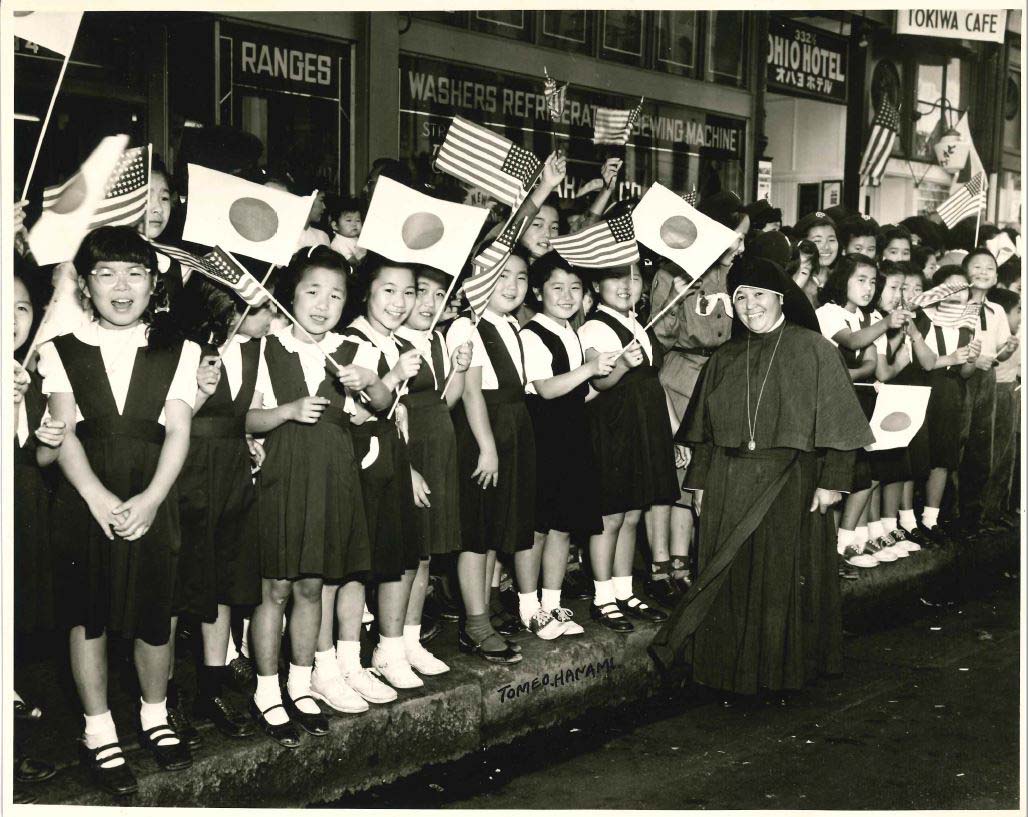
Turning to Japanese immigrants and their children, the historical scholarship on the pre-1965 eras is stronger and primary sources look to be richer.
- Yuki Yamazaki, “St. Francis Xavier School: Acculturation and Enculturation of Japanese Americans in Los Angeles, 1921-1945,” U.S. Catholic Historian, vol. 18, no. 1 (Winter 2000): 54-73.
- Yuki Yamazaki, “American Catholic Missions to Japanese in the United States: Their Intersection of Religion, Cultures, Generations, Genders, and Politics, 1910 to 1970” (diss., Catholic University of America, 2011).
- Michael E. Engh, “‘”Japanese Trimmings on Our American Catholicity’: Contested Ministry to Japanese Immigrants in Los Angeles, 1912–1925,” U.S. Catholic Historian, vol. 31, no. 2 (Spring 2013): 75-93.
Yamazaki relied mostly on materials from the MMA for her article in 2000. By the completion of her dissertation (chaired by Leslie Woodcock Tentler), she had also examined materials from archives of three other religious orders (Jesuits, Divine Word, and Daughters of Mary and Joseph); three archdioceses (LA, SF, and Seattle); and the ACHRC at Catholic University of America. As for Engh, he extracted some information from the 1910s from The Tidings and examined documents from several archives of religious orders, especially the files of a priest of the Paris Foreign Mission Society. These three works emphasize different people, but they help us get a glimpse into the complex lives and experiences of Issei and Nisei regarding the Catholic Church in the West Coast before World War II. Unlike Filipinos, Japanese Catholics were very small in number. Yet many members of the Issei and Nisei, especially non-Catholics, had a lot of interaction with the U.S. Catholic Church due to Catholic educational endeavors.
The short list above reveals another challenge about studying the history of Asian American Catholics: that all three authors have apparently stopped researching this subject. Kathleen Garces-Foley, a faculty at Marymount University (Virginia), has published a great deal on other subjects in American Catholicism, but not Asian Americans. Yuki Yamazaki has been a faculty at Keiwa College (Japan) and hasn’t published more on Japanese American Catholics: at least, to my knowledge, not in English. Michael Engh, a Jesuit priest and former president of Santa Clara University, has apparently retired.
Are we at a complete or near-complete stoppage? I surely hope not. Given the fact that there’s been hardly any deep research into Chinese American Catholics, I was delighted upon learning that two years ago, an undergraduate at Stanford wrote a seminar paper about Chinese American Catholics in San Francisco. This student, Caspar Griffin, took the course “Constructing Race & Religion in America” co-taught by Kathryn Gin Lum and graduate student Johanna Mueller. (The course was a part of the initiative American Religions in a Global Context, which has been directed by Gin Lum.) Griffin then “conducted archival research at the Stanford Library’s Special Collections and ethnographic fieldwork in San Francisco for his final project.” Entitled “Under One Roof: Chinese-American Catholicism in Old St. Mary’s Cathedral,” it was good enough to win an undergraduate best essay award.
This essay is more religious studies than history, strictly speaking. But we sometimes need interests in the present in order to light a spark towards looking into the past long ago. It’s sure better than the alternative, which is no interest at all. I hope that there will be more undergrad and grad students will get into this subject and help us know more.


Leave a Reply