On April 18, I had the pleasure of participating in the day-long conference about Digitizing Vietnam (DVN) at Columbia University. John Phan, its executive director, and other DVN folks did a terrific job putting it together. The focus was digital humanities and AI regarding the present and future of Vietnam studies. By the end of the day, I wasn’t alone in feeling the vibes that this project was something of a paradigm shift.
I was assigned about 15 minutes of speaking at one of the panels, and I focused on two subjects: studying Christmas in Vietnam, and studying the music of Trịnh Công Sơn. The first is a very much underrated subject of inquiry in Vietnam studies. But anecdotal evidence, especially through peer reviews, suggests that more scholars are attentive to the place of Christmas in contemporary Vietnam. It’s a move in the right direction.
Turning to Trịnh Công Sơn (TCS), I began with the collection on TCS currently on the DVN website. The collection is modest at this time, but it avails to the public eight letters from TCS to Bửu Ý over the decades of their friendship. There are also several interviews of others about TCS. It is, again, modest, lean, even bare-boned.
Yet I feel there’s something serious and notable enough about these letters and interviews to build towards, shall we say, the next level of TCS studies. So far, most of the stuff written about TCS and his music has tended towards hagiography. It’s been over half a century since the ending of the Vietnam War. It’s been a quarter-century since TCS’s death. There is sufficient distance to move away from more amateur postures towards his life and music, and to be more critical and scholarly in evaluating life and work. It’s time, I believe, for scholars in and out of Vietnam to shift it more squarely into scholarship and beyond hagiography.
How much hagiography? Although there was already some prior to TCS’s death, most of it had to do with his death at the age of 62 on April 1, 2001. It was a relatively young age, especially in comparison to other well-known composers of Vietnamese popular music. Only Trần Thiện Thanh (TTT), who died in Little Saigon in Orange County, California at the same age in 2005, was comparable in this respect. Of course, countless fans mourned TTT, in Vietnam and the diaspora. And diasporic entertainment companies commemorated him in some programs and recordings. But the commemoration paled in comparison to the outpour on TCS’s life and work following his death. This book was published less than a month after his funeral:
- Nguyễn Trọng Tạo, Nguyễn Thuỵ Kha, Đoàn Tử Huyến, Trịnh Công Sơn: Một người thơ ca, một cõi đi về (Hanoi: Âm Nhạc / Trung tâm Văn hoá Ngôn ngữ Đông Tây, 2001).
There would be a second edition of this book, albeit under a different title: Một cõi Trịnh Công Sơn (Hue: Thuận Hóa / Trung tâm Văn hoá Ngôn ngữ Đông Tây, 2004). In between these versions were at least six books, including four also from 2001:
- Trịnh Công Sơn: Cát bụi lộng lẫy (Hue: Thuận Hóa / Tạp chí Sông Hương, 2021).
- Trịnh Công Sơn, Trần Thanh Phương, et al., Trịnh Công Sơn: Người hát rong qua nhiều thế hệ (HCMC: Trẻ, 2001).
- Lê Minh Quốc, ed., Trịnh Công Sơn: Rơi lệ ru người (Hanoi: Phụ nữ, 2001).
- Trịnh Cung and Nguyễn Quốc Thái, eds., Trịnh Công Sơn: Cuộc Đời – Âm Nhạc – Thơ – Hội Họa & Suy Tưởng (HCMC: Văn Nghệ, 2001).
- Bửu Ý, Trịnh Công Sơn: một nhạc sĩ thiên tài (HCMC: Trẻ / Văn hóa Phương Nam, 2003).
- Nguyễn Đắc Xuân, Trịnh Công Sơn: Có một thời như thế (Hanoi: Văn học, 2003).
There have been many more, including these notable titles:
- Hoàng Phủ Ngọc Tường, Trịnh Công Sơn và cây đàn lya của Hoàng tử bé (HCMC: Trẻ, 2005).
- Nguyễn Hữu Thái Hòa, et al., Vườn xưa: Hành trình âm nhạc Trịnh Công Sơn (HCMC: Trẻ, 2007).
- Ban Mai, Trịnh Công Sơn: Vết chân dã tràng (Hanoi: Lao Động, 2008).
The hagiography is easily spotted from the titles and subtitles. Một nhạc sĩ thiên tài: a musical genius. Cát bụi lộng lẫy: Splendid dust and sand. Người hát rong qua nhiều thế hệ: The troubadour over multiple generations. It wasn’t a surprise that many Vietnamese wanted their voices in these books. They contributed to what John Schafer, in one of the more scholarly publications about TCS, has called the “Trịnh Công Sơn Phenomenon.” (You can read Schafer’s article here.)
Hagiography is among other things a manner of coping with losses, and the outpour could be seen in that light. Moreover, there is absolutely some value from hagiography. In this case, authors and editors collected some of TCS’s writings in some of these books, such as the entire Part 1 of Trịnh Công Sơn: Người hát rong qua nhiều thế hệ. The year 2001 might have been the first time in the postwar era that his writings (which are typically short) were collected.
John Schafer has done more than anyone publishing in English to advance TCS studies; another time, I may discuss his work along with other English publications. For now, I note a couple of issues about his aforementioned article. Its interpretation at times too uncritically takes the words of interlocutors. It also gives an impression that the Republic of Vietnam was just as bad as the postwar Socialist Republic of Vietnam in censoring TCS. I wish Schafer was more even-handed and allowed for finer distinctions between two drastically different regimes. But let these issues slip for now, if only because there wasn’t as much historical scholarship in 2007 about the culture and politics of the RVN.
The TCS hagiography continued well into the 2010s, even the current decades, albeit with a certain interest in analysis. Looking back to the event at Columbia, I was a bit harsh on the lack of seriousness, especially on linguistics, among Vietnamese publications. The initial publications were indeed heavy hagiography. Certain hagiographers, though, contributed to the progress of scholarship by cataloguing the songs of TCS. First and foremost was Phạm Văn Đỉnh, apparently a Vietnamese living in France, who utilized materials from a TCS fan club in France (and its website) and catalogued and annotated 288 songs:
- Phạm Văn Đỉnh, Thư mục ca khúc Trịnh Công Sơn (updated in 2007).
Later, however, some twenty songs were determined to not have been TCS’s. Further research led to a current list of 244 songs. Đỉnh also made one of the first attempts, if not the first, at cataloguing TCS’s published collections of songs. This effort also helped to transition the first half of the first wave into the second half: more serious attempts to analyze the lyrics rather than merely hagiographizing them and their author. Most notable, perhaps, is this book:
- Bích Hạnh, Trịnh Công Sơn: Hạt bụi trong cõi thiên thu (Hanoi: Từ Điện Bách Khoa, 2011).
Nguyễn Thị Bích Hạnh had in fact published a shorter version of this book under a different title: Biểu tượng ngôn ngữ trong ca từ của Trịnh Công Sơn (Hanoi: Khoa học Xã hội, 2009). Reflecting the hagiographical inclination, the 2011 version carries a subtitle, a speck in the eternal realm, that echoes the title of one of his best-known songs. The title of the 2009 version, however, is more academic-sounding: Linguistic symbolism in the lyrics of TCS.
There is more of a sustained effort at analyzing the vocabulary of TCS’s sizeable oeuvre–or at least some of it. It’s largely devoted to words such as đất, cát, bụi, nắng, and mặt trời. Depending on two or three dictionaries for its analysis, the book is very much speculative, even amateurish, in explaining the relationship of a word to the larger lyrical context. Of the little historical information there is, it’s bracketed to the most generic meaning and overwhelmed by the verbose barrage of speculation. In other words, it attempts to imbue further meaning onto the accepted hagiography.
Bùi Vĩnh Phúc was another author who published a book on TCS during this period. Check out this interview of him in 2014 and held in Orange County. I don’t have access to the book, but it apparently reflects the growing interest in TCS’s lyrics. At the University of Đà Nẵng, a graduate student wrote his master’s thesis on English translation of the lyrics.
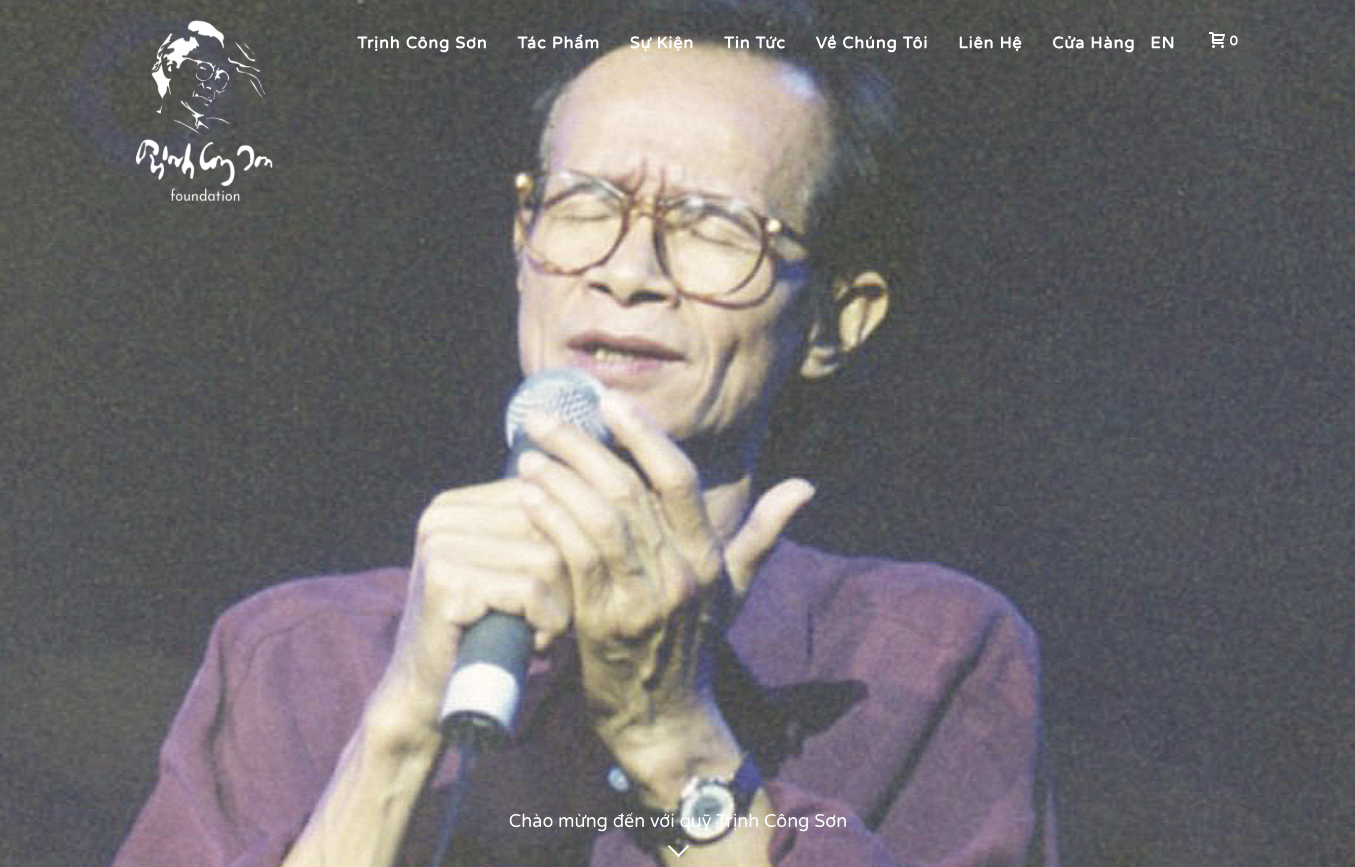
In short, the books above, whose covers are prominently displayed on the website of the Trịnh Công Sơn Foundation, form the bulk of the first wave of TCS studies.
It is time, I hope, for new works that move beyond this hagiographical milieu and into a more critical and scholarly stage of studying TCS. This hope underscored my remarks at the DVN event. The first wave has shown a growing attention to lyrics and language, and it was right to point at the significance of his coinage of new images and phrases. Some of its works look to be right about philosophical and religious traditions. But it is time to move on.
This new wave may include linguistic examinations of the roots of the phrases and joint words that he coined. And a stronger grasp of philosophical and religious traditions that influenced him. And a broader (and deeper) grasp of the musical culture and industry (if not also the visual arts) in the Republic of Vietnam. And a better conceptualization of the kind(s) of Vietnamese nationalism (and not the variety propagated by the communist party at the time) behind his music. Only then that we can elevate TCS studies to a higher plane.


1 Pingback